Where Can I Print a Free Lease Agreement
A lease agreement (or rental agreement) is a document that explains the terms under which a tenant rents a residential or commercial property from a landlord.
Lease agreements are legally-binding contracts that explain the obligations and rights of both the tenant and landlord. Even if you're just renting out a room in your house to a friend or family member, you need a lease agreement for legal protection in case you encounter problems with your tenants.
Find your free printable rental/lease agreement by type below and use it to rent out a property.
Table of Contents
- Residential Lease Agreement Forms [For Landlords]
- Sublease Agreement Forms [For Tenants]
- Commercial/Other Lease Agreement Forms
- Frequently Asked Questions
- Sample Residential Lease Agreement [& Forms by State]
- How to Write a Lease/Rental Agreement
- Legal Information & Guides for Landlords
- How to Lease a Residential Property [Step by Step]
- Common Lease Agreement Disclosures and Addendums
- Landlord and Tenant Laws by State
- Rental/Lease Agreement Glossary
Residential Lease Agreement Sample Forms [For Landlords]
Sample Sublease Agreement Forms [For Tenants]
Sample Commercial/Other Lease Agreement Forms
You can further support your original lease agreement by modifying the terms with a lease amendment. Additionally, you can end an existing lease with a lease termination letter, or extend a rental for another term with a lease renewal.
Frequently Asked Questions
What Is a Lease?
A lease is a legally-binding contract used when a landlord (the "lessor") rents out a property to a tenant (the "lessee"). This written agreement states the terms of the rental, such as how long the tenant will rent the property and how much they will pay, in addition to the repercussions for breaking the agreement.
A lease is also commonly called a lease agreement, a rental agreement, a rental contract, a lease form, a rental lease agreement, an apartment lease, a tenancy agreement, and a house rental agreement.
Why Do I Need a Lease Agreement?
You need a lease agreement because it explains your responsibilities as a landlord, sets rules for the tenants living in your property, and is often required by state law. Having a lease agreement helps you avoid disputes with your tenants and fix problems when they arise.
If you rent out a property but don't use a lease agreement, you could lose rent money, be liable for illegal activities on the property, receive penalties for unpaid utility costs, or spend a lot of money on property damage repairs and lawyer fees. Anyone who rents out a home, land, or a commercial building should have a lease agreement.
All adult tenants must be given a copy of the lease agreement after they sign it. Landlords and property managers should also keep a copy on file.
How Do I Rent Out a Room in My House?
You rent out a room in your house by using a lease agreement that states you're just renting out a room, and not the entire property. If you're a tenant living in a rental property, you can sublet a room to another tenant using a room rental agreement.
Both a standard residential lease and a room rental agreement allow you to establish quiet hours, times guests can visit, how to divide utility payments, and set rules regarding pets, smoking, and parking.
To rent out a room, both parties sign the agreement and the landlord collects a security deposit from the tenant before handing over the keys.
What's the Difference Between a Lease and a Rental Agreement?
The difference between a lease and a rental agreement is the duration of the contract. Lease agreements are typically long term contracts (12 to 24 months), whereas rental agreements are usually short-term (a few weeks or months).
If you're deciding whether a lease or rent is best for you, remember that a lease agreement provides more security, but a rental agreement offers more flexibility.
What Are My Responsibilities as a Landlord?
Your responsibilities as a landlord include the following:
- Repairing and maintaining the normal wear and tear of appliances like the air conditioner or heater.
- Respecting a tenant's right to "quiet enjoyment" (living without disturbances). For example, not making unnecessary visits to the property, and dealing with problems that cause noise (such as dogs barking).
- Providing a safe and clean home to the tenant for the term of the lease. Examples include getting rid of mold, resolving water damage, and fixing ventilation problems.
- Returning the tenant's security deposit if the tenant treats the property with respect, and it's in good condition at the end of the lease term.
- Giving the tenant advance notice when you need to enter the premises to fix something or show someone the property.
Landlords' responsibilities differ according to state landlord–tenant laws, which describe how a landlord should handle access to the property, security deposits, and evictions.
What Happens if a Tenant Violates a Lease?
If a tenant violates a lease, the landlord may try to resolve the problem by giving the tenant a chance to fix it (unless the violation is major, such as using the property to sell or manufacture illegal drugs). If the issue is not resolved within a certain time period (as set by state law), the landlord can begin the eviction process to remove the tenant.
Common lease violations include unpaid rent and utility bills, damage to the property, and the tenant breaking the law.
What Should I Include in a Lease Agreement?
You should include the following information and clauses in a lease agreement:
- Names of all tenants: write the names of every adult who will be living in the property.
- Term: state the duration of the lease, and whether it's for a fixed term or will automatically renew.
- Rent: set the amount of money the tenant will pay in order to live in the property, and which day of the month the rent will be paid on.
- Premises: describe the property and where it is located.
- Security deposit: assign an amount of money the tenant will give the landlord to hold in case of any damages
Depending on your property and where it is located, you may need to include some common disclosure and addendums that address specific situations such as smoking or pets.
Sample Residential Lease Agreement [& Forms by State]
The following standard residential lease agreement works for all states except California, Florida, and Washington, DC.
Standard Residential Lease Agreement
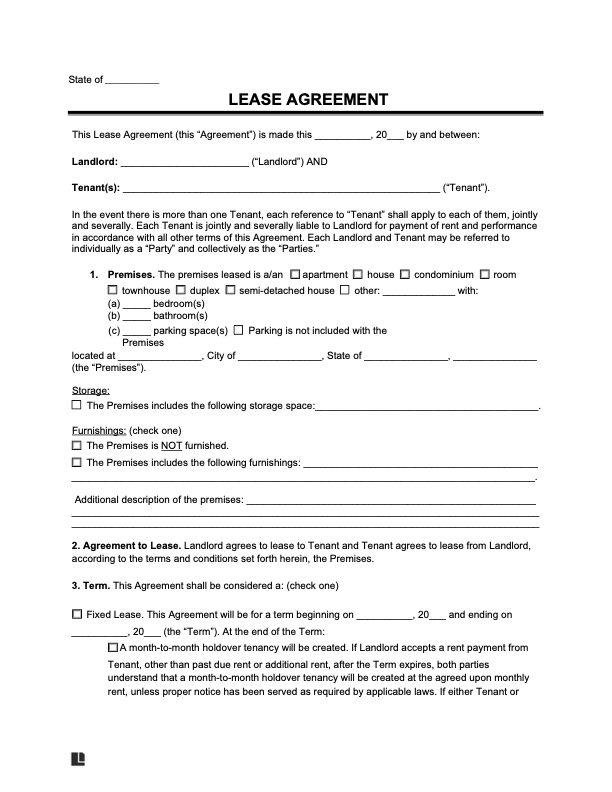
To see a completed residential lease agreement, view our filled-out rental lease example.
Or, find your state-specific residential lease agreement below.
How to Write (Fill Out) a Lease/Rental Agreement
Here's how to write a lease by filling out our free lease agreement template:
1. Name the parties
A simple rental agreement form needs to name the parties signing the lease and where they live. First, you should write down:
- the landlord or property management company and their current address
- the tenant or tenants and their current address
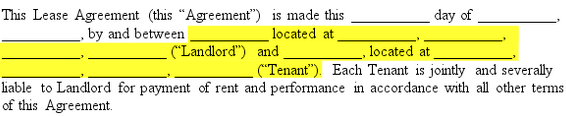
An example of where to write the Tenant and Landlord names in our lease template.
2. Describe the premises
The "premises" are simply the exact address and type of property being rented, such as an apartment, house, or condominium.

3. Define the term of the lease
The "term" is the length of time a tenant will rent the listed property. A standard lease agreement should detail exactly when the lease term begins and ends.
Furthermore, a lease can either be fixed-term or month-to-month.
- A fixed-term rental lease means the agreement is set for a predetermined, or fixed, period of time. This type of lease expires on the end date listed in the agreement (usually up to 6 months, 1 year, or 2 years from the start date).
- A month-to-month rental lease means the agreement is for a one month period with no defined end date. It continues on a per month basis until either the landlord or tenant terminates the agreement.

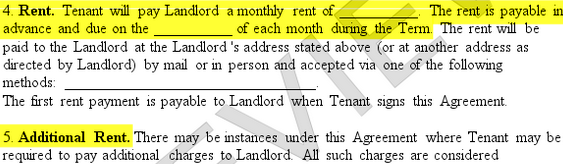
4. Set how much rent is owed
A lease agreement must explicitly list the monthly rental amount, and outline what the consequences are if the rent is late.
It's up to the landlord to decide how much to charge for rent, but the cost is usually comparable to other properties within the same area.
In addition, standard rent control laws may limit the amount that you're able to charge for rent. Check your local rent control ordinance to ensure that your lease agreement is compliant with those regulations.
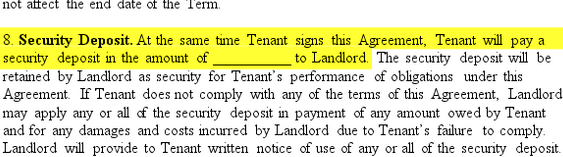
5. Assign a security deposit amount
A security deposit is a set amount of money usually collected at the beginning of the lease. Landlords have the right to collect a security deposit from their tenants, but what that money can be used for is strictly determined by the security deposit laws of your state.
6. Finalize the lease
Once you finish discussing the details with your tenant, remember to:
- Print – print at least two copies of the rental lease for you and the other party
- Sign – sign and date the lease agreement form (both the tenant(s) and landlord)
- Save – file a hard copy of the signed document in a safe place and consider scanning an electronic copy for extra safekeeping.
Legal Information & Guides for Landlords
Whether you're an experienced or first-time landlord, you can use these resources and guides to understand in simple terms what the law says about leases and rental contracts:
- How to Lease a Residential Property [Step by Step]
- Common Lease Agreement Disclosures and Addendums
- Landlord and Tenant Laws by State
- Rental/Lease Agreement Glossary
How to Lease a Residential Property [Step by Step]
Follow the steps below to easily rent out your property:
1. Show your rental unit to tenants

The first step in renting out a house or an apartment is to allow people to view the property. If a tenant likes the property and wants to move in, they will make a verbal offer regarding the monthly rent.
Hosting viewings can be inconvenient if you have multiple properties, so many landlords hire a property management company to show their rental units to potential tenants.
2. Give the tenant a rental application form to fill out
Once you agree on the rent price, the tenant needs to fill out a rental application. This form helps the tenant show that they are trustworthy, and includes information such as their:
- Name
- Current address
- Place of employment
- Income level
- Rental references
The tenant can confirm their workplace using an employment verification letter. This document is also an easy way for renters to show proof of income.
Typically, landlords require a small, nonrefundable fee from the tenant in order to process the rental application.
3. Run a background and credit check

After reviewing the tenant's application, you should run a background check (and/or a credit check). Tenant screening like this can help you avoid scams and problem tenants. The cost is usually paid for by the tenant.
A background check shows if the applicant has a prior criminal history, and a credit check confirms whether the applicant has good or bad credit. Bad credit may be a sign of poor financial planning, which could result in missed rent payments.
Although these checks help you avoid dealing with bad tenants, you shouldn't base your decision to rent the property solely on the results. Many states have strict guidelines on tenant discrimination. Refusing tenancy because of minor criminal offenses or bad credit may be justifiably considered a violation of federal anti-discrimination law.
4. Check the tenant's references

Next, you need to check the references that the tenant included in their rental application form mentioned in step 2 above.
You should contact the references and ask questions such as:
- Did the applicant pay their rent and utilities on time?
- Were there any noise complaints at the tenant's previous apartment?
- Have the police ever been called to the tenant's last rental unit?
- Would you consider renting to this person again?
Rental references are usually current or previous landlords, and can give you insight into the tenant's character and behavior.
5. Create a lease agreement

Once you're happy to rent out your property to a tenant, you need to create a lease/rental agreement in the correct format.
You make a lease agreement by writing it yourself from scratch, filling in a blank lease agreement template that includes all the necessary clauses, or using a lease agreement builder to create a lease specific to your property.
Remember to include:
- The move-in date
- The monthly rent payment amount
- When the rent is due each month
- What will be done about late rent payments
- Who should pay or manage the utilities
- The penalties, if any, of breaking a lease
After you've created the lease contract and gone over everything with your new tenant, both parties sign the agreement. You may need to calculate prorated rent depending on when the tenant moves in.
6. Hand over the keys
Once the lease agreement is completed and signed, give the tenant the keys so they can move in to the property.
To finish the process, a final walkthrough of the unit should be done alongside the tenant. Bring a rental inspection checklist with you, and document the condition of the property before the tenant moves in.
Common Lease Agreement Disclosures and Addendums
Because each rental property is different and laws vary by state, your lease agreement may require additional disclosures and addendums. These documents, attached separately to your lease agreement, inform new or current tenants about issues with your property and their rights.
Download the most common disclosures and addendums below in MS Word (.docx) or Adobe PDF format:
- Asbestos Disclosure (Word) – notifies tenants of the existence of asbestos at the property (required for properties built before 1979).
- Bed Bug Addendum (Word) – explains how both parties should act in the event of a bedbug infestation.
- Carbon Monoxide and Smoke Detector Addendum (Word)– states whether the landlord will provide carbon monoxide/smoke detectors, and how the tenant is responsible for keeping them in good condition.
- Death in Rental Unit Disclosure (Word) – informs the tenant if anyone previously died in the property.
- Disclosure of Lead-Based Hazards (PDF) – notifies tenants of the existence of lead-based paint or other materials (required for properties built before 1978).
- Flood Hazard Area Disclosure (Word) – states whether the property is located in a special flood hazard area.
- Foreclosure Notice (Word) – should be provided to the tenant during the lease if you need to explain that the rental agreement terminates on a specified date.
- Illegal Substance Contamination Disclosure (Word) – notifies the tenant if parts of the property have been contaminated by the manufacturing or storage of an illegal substance (such as methamphetamine).
- Mold Disclosure (Word) – notifies the tenant that the property contains or may contain mold, and whether the landlord will fix it.
- Notice of Abandoned Personal Property (Word) – tells the tenant that they left something in the unit when they moved out, and that they need to collect it before it's thrown out.
- Pet Addendum (Word) – a pet addendum states the rules regarding pets at the property.
- Shared Utilities Disclosure (Word) – explains how how utilities are calculated and shared between multiple residents
- Smoking Lease Addendum (PDF) – a smoking lease addendum tells the tenant whether they can smoke tobacco or marijuana on the property
Landlord and Tenant Laws by State
Federal law recognizes that landlords and tenants have individual legal rights and obligations. Find out what the law in your state says about your rights using the table below, or check the following specific laws for your property:
- State Laws on Landlord's Access to Rental Property
- Security Deposit Laws
- Eviction Laws
State Laws on Landlord's Access to Rental Property
Tenants have the right to privacy when they rent a property. However, there may be situations when a landlord needs to access the property, such as for maintenance or inspections.
Nearly every state requires a landlord to give advance notice to their tenants before they access a rental unit. Use the table below to check how much notice you need to give in your state, and check the relevant law:
Security Deposit Laws
Each state regulates the maximum amount of money a landlord can collect from a tenant as a security deposit. Some states also require landlords to return security deposits to their tenants within a certain amount of time (potentially with interest).
Usually, a landlord can deduct the following costs from the tenant's security deposit:
- Unpaid rent
- Cleaning costs
- Key replacement costs
- Cost to repair damages above ordinary wear and tear
- Any other amount legally allowable under the lease
Use the table below to see the maximum security deposit limit in your state, whether it needs to be held in a separate account, and how much time you have to refund it after the lease ends:
| State | Maximum Deposit Limit | Held in Separate Account | Refund | Law |
|---|---|---|---|---|
| AL | 1 month's rent | Not required | 35 days to return deposit | § 35-9A-201 |
| AK | 2 months' rent, unless monthly rent is greater than $2000 | Escrow account required | - 14 days to return deposit - 30 days to return deposit if tenant doesn't provide proper notice | § 34.03.070 |
| AZ | 1½ months' rent, unless tenant volunteers to pay more | Not required | 14 days to return deposit | § 33-1321 |
| AR | 2 months' rent unless landlord owns fewer than 6 rental units | Not required | 60 days to return deposit | § 18-16-304, 18-16-305 |
| CA | 2 months rent (if unfurnished) or 3 months' rent (if furnished) | Not required | 21 days to return deposit | Civil Code 1950.5 |
| CO | No regulation | Not required | - 30 days to return deposit unless otherwise stated in the lease - 60 days maximum if not stated in the lease | § 38-12-103, 38-12-104 |
| CT | - 2 months' rent if tenant is under 62 years old - 1 month's rent if tenant is over 62 years old | Interest-bearing account required | 30 days to return deposit | § 47a-21 to 47a-22a |
| DE | 1 month's rent for 1-year lease agreements (if unfurnished) | Escrow account required | 30 days to return deposit | Title 25, Chapter 53 |
| FL | No regulation | Interest-bearing or non interest-bearing escrow account required (landlord's choice) | - 15 days to return deposit - 30 days if any amount is retained | § 83.49 |
| GA | No regulation | Escrow account required except if landlord owns fewer than 11 rental units (unless managed by a third party) | 30 days to return deposit | § 44-7-31 to 44-7-37 |
| HI | 1 month's rent | Not required | 14 days to return deposit | § 521-44 |
| ID | No regulation | Not required | - 21 days to return deposit unless otherwise stated in the lease - 30 days maximum if not stated in the lease | § 6-321 |
| IL | No regulation | Not required | 45 days to return deposit | 765 ILCS 705/ |
| IN | No regulation | Not required | - 21 days to return deposit unless otherwise stated in the lease - 30 days maximum if not stated in the lease | § 32-31-3 |
| IA | 2 months' rent | Federally-insured account required | 30 days to return deposit | § 562A.12 |
| KS | 1 month's rent (if unfurnished) or 1½ months' rent (if furnished) | Not required | 30 days to return deposit | § 58-2550 |
| KY | No regulation | Escrow account required | 30 days to return deposit | § 383.580 |
| LA | No regulation | Not required | 30 days to return deposit | RS 9:3251 |
| ME | 2 months' rent | Not required | 30 days to return deposit | Chapter 710-A |
| MD | 2 months' rent | Escrow account required | 45 days to return deposit | § 8-203 |
| MA | 1 month's rent | Interest-bearing escrow account required | 30 days to return deposit | Chapter 186, Section 15B |
| MI | 1½ months' rent | Not required | 30 days to return deposit | § 554.602 to 554.615 |
| MN | No regulation | Not required | 21 days to return deposit | § 504B.178 |
| MS | No regulation | Not required | 45 days to return deposit | § 89-8-21 |
| MO | 2 months' rent | Not required | 30 days to return deposit | § 535.300 |
| MT | No regulation | Not required | - 10 days to return deposit - 30 days if any amount is retained | § 70-25-201 to 70-25-206 |
| NE | 1 month's rent | Not required | 14 days to return deposit | § 17-1416 |
| NV | 3 months' rent | Not required | 30 days to return deposit | § 118A.242 to 118A.250 |
| NH | 1 month's rent or $100 (whichever is greater) | Not required | 30 days to return deposit | § 540-A:6 to 540-A:8 |
| NJ | 1½ months' rent | Not required | 30 days to return deposit | § 46:8-19 |
| NM | - 1 month's rent for lease terms less than 1 year - No limit for lease terms greater than 1 year | Not required | 30 days to return deposit | § 47-8-18 |
| NY | No regulation | Not required | 14 days to return deposit | Emergency Tenant Protection Act 576/74 |
| NC | - 2 weeks' rent for week-to-week lease agreements - 1½ months' rent for month-to-month lease agreements - 2 months' rent for yearly leases | Trust account or bank bond required | - 30 days to return deposit - 60 days to return deposit if damages exceed 1 month's rent | Article 6 Tenant Security Deposit Act |
| ND | 1 month's rent | Escrow account required | 30 days to return deposit | § 47-16-07.1 |
| OH | No regulation | Not required | 30 days to return deposit | § 5321.16 |
| OK | No regulation | Federally-insured escrow account required | 30 days to return deposit | Title 41 §41-115 |
| OR | No regulation | Not required | 31 days to return deposit | ORS 90.300 |
| PA | 2 months' rent | Escrow account required for deposits greater than $100 or any amount held for longer than 2 years | 30 days to return deposit | Landlord Tenant Act Section 511-512 |
| RI | 1 month's rent | Not required | 20 days to return deposit | § 34-18-19 |
| SC | No regulation | Not required | 30 days to return deposit | § 27-40-410 |
| SD | 1 month's rent | Not required | 14 days to return deposit | § 43-32-6.1, § 43-32-24 |
| TN | No regulation | Escrow account required | 30 days to return deposit | § 66-28-301 |
| TX | No regulation | Not required | 30 days to return deposit | § 92.101 - 92.110 |
| UT | No regulation | Not required | 30 days to return deposit | Title 57 Chapter 17 |
| VT | No regulation | Not required | 14 days to return deposit | 9 V.S.A. § 4461 |
| VA | 2 months' rent | Not required | 45 days to return deposit | § 55.1-1226 |
| WA | No regulation | Escrow account required | 21 days to return deposit | § 59.18.253, 59.18.260 - 59.18.285 |
| WV | No regulation | Not required | 60 days to return deposit | Chapter 37 Article 6A |
| WI | No regulation | Not required | 21 days to return deposit | ATCP § 134.06 |
| WY | No regulation | Not required | - 30 days to return deposit - 60 days if any amount is retained | § 1-21-1208 |
Eviction Laws
If a tenant is causing problems or not paying rent, the landlord can evict them from the property using an eviction notice.
Use the table below to find out which type of notice you need to provide, and which laws apply:
| State | Notice to Quit or Leave | Notice to Pay or Leave | Law |
|---|---|---|---|
| Alabama | 14 days | 7 days | § 35-9A-421 |
| Alaska | 10 days | 7 days | § 34-3-160, § 34-3-220 |
| Arizona | 10 days | 5 days | § 33-1368 |
| Arkansas | 14 days | 5 days | § 18-60-304, § 18-17-901 |
| California | 3 days | 3 days | Code of Civil Procedure 1161 |
| Colorado | 3 days | 3 days | § 13-40-107, § 13-40-104 |
| Connecticut | 15 days | 3 days | § 47a-23 |
| Delaware | 7 days | 5 days | Title 25, Chapter 55 § 5513, Title 25, Chapter 55 §5502 |
| Florida | 7 days | 3 days | § 83.56 |
| Georgia | 0 days | Dependent on lease agreement | § 44-7-50 |
| Hawaii | 10 days | 5 days | § 521-72, § 521-68 |
| Idaho | 3 days | 3 days | § 6-303 |
| Illinois | 10 days | 5 days | 735 ILCS 5/9-210, 735 ILCS 5/9-209 |
| Indiana | 0 days | 10 days | § 32-31-1-6 to § 32-31-1-9 |
| Iowa | 7 days | 3 days | § 562A.27 |
| Kansas | - 14 days to cure - 30 days to vacate | - 3 days - 5 days if notice is mailed | § 58-2564, § 58-2507 |
| Kentucky | 14 days | 7 days | § 383.665, § 383.660 |
| Louisiana | 5 days | 5 days | CCP 4701 |
| Maine | 7 days | 7 days | Chapter 710, Title 14 § 6002 |
| Maryland | 30 days | Dependent on lease agreement | § 8-401 to 8-402 |
| Massachusetts | 0 days | 14 days | Chapter 186, Section 11, 11A |
| Michigan | 0 days | 7 days | § 600.5714, § 554.134 |
| Minnesota | 0 days | Dependent on lease agreement | § 504B.135 |
| Mississippi | 30 days | 3 days | § 89-7-27, § 89-8-13 |
| Missouri | 0 days | Dependent on lease agreement | § 441.040, § 535.060 |
| Montana | - 14 days - 3 days if pet or guest problem | 3 days | § 70-24-422 |
| Nebraska | - 14 days to cure - 30 days to vacate | 3 days | § 76-1431 |
| Nevada | 5 days | 5 days | § 40.2512 |
| New Hampshire | 30 days | 7 days | § 540:3 |
| New Jersey | 30 days | Dependent on lease agreement | N.J.S.A. 2A:18-53 |
| New Mexico | 7 days | 3 days | § 47-8-33 |
| New York | 0 days or dependent on the lease agreement | 3 days | § 711, § 753 |
| North Carolina | 0 days | 10 days | § 42-3 |
| North Dakota | 3 days | 3 days | § 47-32 |
| Ohio | 3 days | 3 days | § 1923.02, § 1923.04 |
| Oklahoma | - 10 days to cure - 15 days to vacate | 5 days | Title 41 § 41-131, 132 |
| Oregon | 14 days | 3 days | ORS 90.392, 90.394 |
| Pennsylvania | - 15 days - 30 days if tenant has lived there for over one year | 10 days | Landlord Tenant Act Section 501 |
| Rhode Island | 21 days | 5 days | § 34-18-36, §34-18-35 |
| South Carolina | 14 days | 5 days | § 27-40-710 |
| South Dakota | 3 days | 3 days | § 43-32-18, § 21-6-2 |
| Tennessee | - 14 days to cure - 30 days to vacate | 14 days | § 66-7-109, § 66-28-505 |
| Texas | 3 days | 3 days | § 24.005 |
| Utah | 3 days | 3 days | Title 78B Chapter 6 § 802 |
| Vermont | 30 days | 14 days | 9 V.S.A. § 4467 |
| Virginia | - 21 days to cure - 30 days to vacate | 5 days | § 55.1-1245, § 55.1-1415 |
| Washington | 10 days | 3 days | § 59.12.030 |
| West Virginia | 0 days | Dependent on lease agreement | Chapter 55 Article 3A |
| Wisconsin | 5 days | 5 days | § 704.17 |
| Wyoming | 3 days | 3 days | § 1-21-1003 |
Rental/Lease Agreement Glossary
Here are some useful definitions for the legal language commonly used in lease and rental agreement forms:
- Access: the right to enter a property.
- Accidents: manmade or naturally occurring events that may damage a property (fire, flood, earthquake, etc.).
- Alterations: modifications made to a property.
- Appliances: common home equipment like a refrigerator or dishwasher.
- Assignment: the transfer of interest in a lease.
- Attorney Fees: a payment made to a lawyer.
- Condemnation: the government seizure of private property for a public purpose such as the construction of a highway.
- Default: when a breach of contract occurs and persists such as not paying rent or violating other terms of a rental lease agreement.
- Furniture: common home equipment such as couches, tables, beds, etc.
- Guarantor / Co-Signer: someone that is held accountable for paying rent if the tenant is unable to do so.
- Guests: short-term occupants of a rental property.
- Joint and several liability: where two or more people are independently held accountable for damages, regardless of who is at fault.
- Late Rent Fee: an additional, reasonable sum of money paid by a tenant after making a rent payment past the due date listed in the lease agreement.
- Noise Policy: a provision of a lease agreement outlining "quiet hours" in the apartment building, condominium, or neighborhood.
- Notice: a written announcement of some fact or observation.
- Option to Purchase: the tenant's right to purchase a piece of rental property at a later date.
- Parking: designated spaces where the tenant can keep their vehicles.
- Pet Policy: the permission or restriction of a tenant's ability to have an animal in a rental property.
- Property Maintenance: the process of preserving a rental unit and who is responsible for doing so. Such as cutting the grass, taking out the garbage, or unclogging the kitchen and bathroom drains.
- Renewal: a tenant's option to continue the lease.
- Renter's Insurance: a paid policy which protects personal belongings against theft or damage.
- Severability: a clause of a lease stating that if one part of the agreement is invalid for any reason, the rest of the lease is still enforceable.
- Smoking Policy: the permission or restriction of a tenant's ability to smoke inside a rental property.
- Sublet: a temporary housing arrangement between a current tenant and a new tenant to rent all or part of the currently leased property. The subletting period must be for less than the lease term.
- Successor: someone who takes over the obligations of a lease from a tenant or landlord.
- Utilities: a public or private service supplying electricity, water, gas, or trash collection to a property.
- Waterbed: a water-filled furnishing used to sleep and not typically permitted in most rental properties
Where Can I Print a Free Lease Agreement
Source: https://legaltemplates.net/form/lease-agreement/
0 Response to "Where Can I Print a Free Lease Agreement"
Post a Comment