Its a Lie

A lie is an assertion that is believed to be false, typically used with the purpose of deceiving someone.[1] [2] [three] [4] The exercise of communicating lies is called lying. A person who communicates a lie may exist termed a liar. Lies may serve a variety of instrumental, interpersonal, or psychological functions for the individuals who use them.
Generally, the term "lie" carries a negative connotation, and depending on the context a person who communicates a prevarication may be subject to social, legal, religious, or criminal sanctions.
Although people in many cultures believe that deception can be detected by observing nonverbal behaviors (e.g. not making eye contact, fidgeting, stuttering) research indicates that people overestimate both the significance of such cues and their ability to make accurate judgements most charade.[v] [6] More generally, people'southward power to make truth judgments is affected by biases towards accepting incoming information and interpreting feelings as evidence of truth. People don't always check incoming assertions against their memory.[7]
Types and associated terms
- A barefaced, bald-faced or bold-faced lie is an impudent, brazen, shameless, flagrant, or audacious lie that is sometimes but non always undisguised and that information technology is even then not e'er obvious to those hearing it.[8]
- A large lie is one that attempts to trick the victim into believing something major, which will probable be contradicted by some information the victim already possesses, or by their common sense. When the lie is of sufficient magnitude it may succeed, due to the victim'south reluctance to believe that an untruth on such a 1000 calibration would indeed be concocted.[9]
- A black lie is about simple and callous selfishness. They are commonly told when others gain nothing, and the sole purpose is either to get ourselves out of trouble (reducing impairment against ourselves), or to proceeds something we want (increasing benefits for ourselves). [10] [ meliorate source needed ]
- A blue prevarication is a class of lying that is told purportedly to benefit a collective or "in the proper name of the collective good". The origin of the term "blue lie" is possibly from cases where law officers made imitation statements to protect the police force or to ensure the success of a legal case against an accused.[11] This differs from the blue wall of silence in that a blueish prevarication is not an omission only a stated falsehood.
- An April fool is a prevarication or hoax told/performed on April Fools' Day.
- To bluff is to pretend to have a adequacy or intention one does not possess.[9] Bluffing is an deed of charade that is rarely seen as immoral when it takes identify in the context of a game, such every bit poker, where this kind of charade is consented to in advance past the players. For instance, gamblers who deceive other players into thinking they have different cards to those they actually concur, or athletes who hint that they will move left and so dodge right are non considered to be lying (also known every bit a feint or juke). In these situations, deception is acceptable and is commonly expected as a tactic.
- Bullshit (besides B.S., bullcrap, bull) does non necessarily accept to exist a complete fabrication. While a lie is related past a speaker who believes what is said is false, bullshit is offered past a speaker who does not care whether what is said is true because the speaker is more concerned with giving the hearer some impression. Thus bullshit may be either true or false, but demonstrates a lack of business organisation for the truth that is probable to atomic number 82 to falsehoods.[12]

A motivational poster about lying declares "An ostrich just thinks he 'covers up'"
- A encompass-upward may exist used to deny, defend, or obfuscate a prevarication, errors, embarrassing actions, or lifestyle, and/or lie(s) fabricated previously.[9] I may deny a lie made on a previous occasion, or alternatively, one may claim that a previous prevarication was not every bit egregious as it was. For example, to claim that a premeditated lie was really "just" an emergency lie, or to claim that a self-serving lie was really "only" a white lie or noble lie. This should not exist dislocated with confirmation bias in which the deceiver is deceiving themselves.
- Defamation is the communication of a imitation statement that harms the reputation of an individual person, business, product, group, government, religion, or nation.[9]
- To deflect is to avoid the subject that the prevarication is most, non giving attention to the prevarication. When attention is given to the subject the lie is based around, deflectors ignore or pass up to answer. Skillful deflectors are passive-aggressive, who when confronted with the subject cull to ignore and not respond.[xiii]
- Disinformation is intentionally simulated or misleading information that is spread in a calculated way to deceive target audiences.[9]
- An exaggeration occurs when the most cardinal aspects of a argument are true, merely only to a certain caste. It likewise is seen as "stretching the truth" or making something appear more powerful, meaningful, or real than it is. Saying that someone devoured most of something when they only ate one-half would exist considered an exaggeration. An exaggeration might be easily institute to be a hyperbole where a person'southward statement (i.eastward. in breezy spoken communication, such as "He did this one million times already!") is meant not to be understood literally.[9]
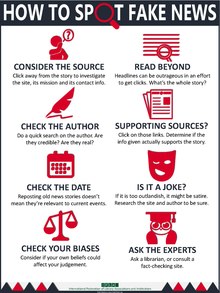
- Fake news is supposed to exist a type of yellow journalism that consists of deliberate misinformation or hoaxes spread via traditional print and broadcast news media or online social media.[14] Sometimes the term is applied as a deceptive device to deflect attention from uncomfortable truths and facts, however.
- A fib is a lie that is like shooting fish in a barrel to forgive due to its subject area being a trivial matter; for example, a child may tell a fib by challenge that the family domestic dog broke a household vase, when the child was the one who bankrupt information technology.[9]
- Fraud refers to the act of inducing another person or people to believe a lie in lodge to secure material or financial proceeds for the liar. Depending on the context, fraud may subject the liar to ceremonious or criminal penalties.[15]
- A grey lie is told partly to help others and partly to assist ourselves. It may vary in the shade of gray, depending on the residue of help and harm. Gray lies are, near by definition, difficult to analyze. For example you tin lie to assist a friend out of trouble but then proceeds the reciprocal benefit of them lying for yous while those they take harmed in some way lose out. [ten] [ better source needed ]
- A half-truth is a deceptive argument that includes some element of truth. The statement might be partly true, the argument may be totally true, but only part of the whole truth, or it may utilize some deceptive element, such as improper punctuation or double significant, particularly if the intent is to deceive, evade, arraign, or misrepresent the truth.[16]
- An honest lie (or confabulation) may be identified past verbal statements or actions that inaccurately describe the history, background, and present situations. There is mostly no intent to misinform and the individual is unaware that their information is false. Because of this, it is not technically a prevarication at all since, by definition, at that place must be an intent to deceive for the statement to exist considered a prevarication.
- Jocose lies are lies meant in jest, intended to exist understood equally such by all present parties. Teasing and irony are examples. A more than elaborate case is seen in some storytelling traditions, where the storyteller's insistence that the story is the absolute truth, despite all evidence to the reverse (i.e., alpine tale), is considered humorous. There is contend virtually whether these are "existent" lies, and different philosophers hold different views. The Crick Crack Club in London arranges a yearly "K Lying Contest" with the winner being awarded the coveted "Hodja Loving cup" (named for the Mulla Nasreddin: "The truth is something I have never spoken."). The winner in 2010 was Hugh Lupton. In the United States, the Burlington Liars' Guild awards an almanac championship to the "World Champion Liar."[17]
- Lie-to-children is a phrase that describes a simplified explanation of technical or circuitous subjects as a teaching method for children and laypeople. While lies-to-children are useful in teaching complex subjects to people who are new to the concepts discussed, they tin can promote the creation of misconceptions among the people who listen to them. The phrase has been incorporated past academics within the fields of biology, development, bioinformatics, and the social sciences. Media use of the term has extended to publications including The Conversation and Forbes.
- Lying by omission , as well known equally a continuing misrepresentation or quote mining, occurs when an important fact is left out in order to foster a misconception. Lying by omission includes the failure to correct pre-existing misconceptions. For instance, when the seller of a car declares it has been serviced regularly, but does not mention that a fault was reported during the last service, the seller lies by omission. Information technology may be compared to dissimulation. An omission is when a person tells most of the truth, but leaves out a few central facts that therefore, completely obscures the truth.[thirteen]

Consumer protection laws ofttimes mandate the posting of notices, such as this one which appears in all automotive repair shops in California.
- Lying in trade occurs when the seller of a product or service may advertise untrue facts almost the production or service in guild to gain sales, peculiarly by competitive reward. Many countries and states have enacted consumer protection laws intended to combat such fraud.
- A memory hole is a mechanism for the amending or disappearance of inconvenient or embarrassing documents, photographs, transcripts, or other records, such as from a website or other archive, particularly as part of an attempt to give the impression that something never happened.[eighteen] [19]
- Minimization is the opposite of exaggeration. Information technology is a blazon of charade[twenty] involving denial coupled with rationalization in situations where complete denial is implausible.
- Mutual deceit is a situation wherein lying is both accepted and expected[21] or that the parties mutually accept the deceit in question.[22] This tin can be demonstrated in the case of a poker game wherein the strategies rely on deception and bluffing to win.[22]

- A noble lie, which as well could exist called a strategic untruth, is 1 that normally would cause discord if uncovered, but offers some benefit to the liar and assists in an orderly club, therefore, potentially being benign to others. Information technology is often told to maintain law, order, and condom.
- Paltering is the active use of selective truthful statements to mislead.[24]
- Paternalistic charade is a lie told considering it is believed (perhaps incorrectly) that the deceived person will benefit.
- In psychiatry, pathological lying (besides chosen compulsive lying, pseudologia fantastica, and mythomania) is a beliefs of habitual or compulsive lying.[25] [26] Information technology was kickoff described in the medical literature in 1891 by Anton Delbrueck.[26] Although information technology is a controversial topic,[26] pathological lying has been defined as "falsification entirely disproportionate to whatsoever discernible stop in view, may exist extensive and very complicated, and may manifest over a period of years or even a lifetime".[25] The private may exist aware they are lying, or may believe they are telling the truth, beingness unaware that they are relating fantasies.
- Perjury is the deed of lying or making verifiably false statements on a material affair under adjuration or affirmation in a court of police, or in whatsoever of various sworn statements in writing. Perjury is a crime, because the witness has sworn to tell the truth and, for the credibility of the court to remain intact, witness testimony must exist relied on as truthful.[ix]
- A polite lie is a prevarication that a politeness standard requires, and that usually is known to be untrue by both parties. Whether such lies are acceptable is heavily dependent on civilisation. A common polite lie in international etiquette may be to reject invitations because of "scheduling difficulties", or due to "diplomatic disease". Similarly, the butler lie is a minor lie that usually is sent electronically and is used to terminate conversations or to save face.[27]
- Puffery is an exaggerated merits typically institute in advertisement and publicity announcements, such as "the highest quality at the lowest price", or "ever votes in the best interest of all the people". Such statements are unlikely to be true – simply cannot be proven faux and and so, exercise non violate trade laws, especially equally the consumer is expected to be able to determine that it is not the absolute truth.[28]
- A ruby lie is nearly spite and revenge. It is driven by the motive to impairment others even at the expense of harming oneself. When nosotros are angry at others, perhaps considering of a long feud or where we feel they have wronged us in some mode, nosotros feel a sense of betrayal and so seek retributive justice, which we may manipulate without thought of upshot. [ten] [ better source needed ]
- The phrase "speaking with a forked tongue" means to deliberately say ane thing and mean another or, to be hypocritical, or act in a duplicitous fashion. This phrase was adopted by Americans around the fourth dimension of the Revolution, and may be found in abundant references from the early on nineteenth century – often reporting on American officers who sought to convince the Ethnic peoples of the Americas with whom they negotiated that they "spoke with a straight and not with a forked tongue" (as for example, President Andrew Jackson told members of the Creek Nation in 1829).[29] According to one 1859 account, the saying that the "white human spoke with a forked tongue" originated in the 1690s, in the descriptions by the indigenous peoples of French colonials in America inviting members of the Iroquois Confederacy to attend a peace conference, simply when the Iroquois arrived, the French had set an ambush and proceeded to slaughter and capture the Iroquois.[30]
- Weasel word is an breezy term[31] for words and phrases aimed at creating an impression that a specific or meaningful statement has been made, when in fact merely a vague or cryptic claim has been communicated, enabling the specific meaning to be denied if the statement is challenged. A more formal term is equivocation.
- A white lie is a harmless or footling lie, especially ane told in order to exist polite or to avoid pain someone's feelings or stopping them from existence upset by the truth.[32] [33] [34] A white lie as well is considered a lie to exist used for greater good (pro-social behavior). It sometimes is used to shield someone from a hurtful or emotionally-damaging truth, especially when not knowing the truth is deemed by the liar every bit completely harmless.
Consequences
The potential consequences of lying are manifold; some in particular are worth considering. Typically lies aim to deceive, when deception is successful, the hearer ends upwards acquiring a false conventionalities (or at least something that the speaker believes to be false). When deception is unsuccessful, a lie may be discovered. The discovery of a prevarication may discredit other statements past the same speaker, staining his reputation. In some circumstances, it may also negatively affect the social or legal continuing of the speaker. Lying in a courtroom of law, for instance, is a criminal crime (perjury).[35]
Hannah Arendt spoke almost extraordinary cases in which an entire order is being lied to consistently. She said that the consequences of such lying are "not that you believe the lies, simply rather that nobody believes anything any longer. This is because lies, by their very nature, have to exist inverse, and a lying government has constantly to rewrite its own history. On the receiving terminate you get not merely one prevarication – a lie which you could proceed for the rest of your days – but yous become a great number of lies, depending on how the political air current blows."[36]
Detection
The question of whether lies tin can exist detected reliably through nonverbal has been the subject of frequent study. While people in many cultures believe that deception can be indicated by behaviors such as looking abroad, fidgeting, or stammering, this is not supported by research.[five] [6] A 2019 review of research on deception and its detection through nonverbal beliefs concludes that people tend to overestimate both the reliability of nonverbal behavior as an indicator of deception, and their power to make accurate judgements about deception based on nonverbal behavior.[5] [37]
Polygraph "lie detector" machines mensurate the physiological stress a discipline endures in a number of measures while giving statements or answering questions. Spikes in stress indicators are purported to reveal lying. The accurateness of this method is widely disputed. In several well-known cases, application of the technique has been shown to have given incorrect results.[ examples needed ] Notwithstanding, it remains in use in many areas, primarily every bit a method for eliciting confessions or employment screening. The unreliability of polygraph results are the basis of such evaluations not being admissible as court prove and, more often than not, the technique is perceived to be pseudoscience.[38]
A recent study plant that composing a lie takes longer than telling the truth and thus, the time taken to answer a question may be used as a method of lie detection,[39] however, it also has been shown that instant answers with a lie may be proof of a prepared lie. A recommendation provided to resolve that contradiction is to endeavour to surprise the subject field and observe a midway answer, not too quick, nor too long.[40]
Ethics

Utilitarian philosophers take supported lies that achieve good outcomes – white lies.[41] In his 2008 book, How to Make Proficient Decisions and Be Correct All the Fourth dimension, Iain King suggested a credible rule on lying was possible, and he defined it as: "Deceive only if y'all tin change behaviour in a way worth more than the trust you lot would lose, were the charade discovered (whether the deception actually is exposed or not)."[42]
Stanford Law professor Deborah L. Rhode articulated three rules she says ethicists by and large agree distinguish "white lies" from harmful lies or cheating:[43]
- A disinterested observer would conclude that the benefits outweigh the harms
- There is no alternative
- If anybody in similar circumstances acted similarly, order would be no worse off
Aristotle believed no general rule on lying was possible, because anyone who advocated lying could never be believed, he said.[44] Although the philosophers St. Augustine, St. Thomas Aquinas, and Immanuel Kant, condemned all lying,[41] Thomas Aquinas did advance an argument for lying, however. Co-ordinate to all three, there are no circumstances in which, ethically, ane may lie. Fifty-fifty if the just way to protect oneself is to lie, it is never ethically permissible to prevarication even in the face of murder, torture, or any other hardship. Each of these philosophers gave several arguments for the ethical footing against lying, all compatible with each other. Among the more than important arguments are:
- Lying is a perversion of the natural faculty of speech, the natural end of which is to communicate the thoughts of the speaker.
- When one lies, ane undermines trust in society.
In Lying, neuroscientist Sam Harris argues that lying is negative for the liar and the person who's being lied to. To say lies is to deny others access to reality, and oft nosotros cannot conceptualize how harmful lies can be. The ones we lie to may fail to solve problems they could have solved but on a basis of skilful information. To lie also harms oneself, makes the liar distrust the person who's beingness lied to.[45] Liars generally feel badly almost their lies and sense a loss of sincerity, authenticity, and integrity. Harris asserts that honesty allows one to accept deeper relationships and to bring all dysfunction in one's life to the surface.
In Human, All Too Homo, philosopher Friedrich Nietzsche suggested that those who refrain from lying may do so only because of the difficulty involved in maintaining lies. This is consistent with his general philosophy that divides (or ranks) people according to forcefulness and ability; thus, some people tell the truth only out of weakness.
In other species
Possession of the capacity to lie amid non-humans has been asserted during linguistic communication studies with great apes. In 1 instance, the gorilla Koko, when asked who tore a sink from the wall, pointed to one of her handlers and and so laughed.[46]
Deceptive trunk language, such equally feints that mislead as to the intended management of attack or flight, is observed in many species. A mother bird deceives when she pretends to have a broken wing to divert the attention of a perceived predator – including unwitting humans – from the eggs in her nest, instead to her, as she draws the predator abroad from the location of the nest, most notably a trait of the killdeer.[47]
Cultural references

Shut-up of the bronze statue depicting a walking Pinocchio, named Walking to Borås by Jim Dine
- Carlo Collodi's Pinocchio is a wooden puppet character oft led into trouble by his propensity to lie; his olfactory organ grows with every one. Hence, long noses accept get a caricature of liars.
- The Boy Who Cried Wolf, a fable attributed to Aesop about a boy who continually lies that a wolf is coming. When a wolf does appear, nobody believes him anymore.
- A famous anecdote past Parson Weems claims that George Washington in one case cut at a cherry tree with a hatchet when he was a pocket-sized child. His male parent asked him who cut the cherry tree and Washington confessed his crime with the words: "I'm distressing, begetter, I cannot tell a lie."
- To Tell the Truth was the originator of a genre of game shows with three contestants challenge to be a person simply i of them is.
- Glenn Kessler, a journalist at The Washington Post, awards ane to 4 Pinocchios to politicians in his Washington Mail Fact Checker weblog.[48]
- The cliché "All is fair in love and war",[49] [50] asserts justification for lies used to gain advantage in these situations.
- Sun Tzu declared that "All warfare is based on deception." Machiavelli advised in The Prince that a prince must hibernate his behaviors and get a "keen liar and deceiver."[51]
- Thomas Hobbes wrote in Leviathan: "In war, forcefulness and fraud are the ii cardinal virtues."

- The concept of a retention hole was outset popularized past George Orwell's dystopian novel, 19 Eighty-Four, where the Party's Ministry building of Truth systematically re-created all potential historical documents, in effect re-writing all of history to friction match the often-changing country propaganda. These changes were complete and undetectable.
- In the movie Big Fat Liar, the story producer Marty Wolf (a notorious and proud liar) steals a story from pupil Jason Shepard, telling of a character whose lies become out of command to the point where each prevarication he tells causes him to abound in size.
- In the motion-picture show Liar Liar, the lawyer Fletcher Reede (Jim Carrey) cannot lie for 24 hours, due to a wish of his son that magically came true.
- In the 1985 film Max Headroom, the title character comments that one can always tell when a politician lies considering "their lips move". The joke has been widely repeated and rephrased.
- Larry-Boy! And the Fib from Outer Infinite! was a Veggie Tales story of a criminal offense-fighting super-hero with super-suction ears, having to stop an conflicting, calling himself "Fib", from destroying the town of Bumblyburg due to the lies that caused Fib to grow. Telling the truth is the moral to this story.
- Lie to Me is a television series based on behavior analysts who read lies through facial expressions and torso linguistic communication.
- The Invention of Lying is a 2009 movie depicting the fictitious invention of the first lie, starring Ricky Gervais, Jennifer Garner, Rob Lowe, and Tina Fey.
- The Adventures of Baron Munchausen tell the story well-nigh an eighteenth-century baron who tells outrageous, unbelievable stories, all of which he claims are true.
- In the games Grand Theft Motorcar IV and Grand Theft Auto Five, there'southward an agency named FIB, a parody of the FBI, which is known to cover up stories, cooperate with criminals, and extract information with the utilize of lying.
Psychology
It is asserted that the chapters to lie is a talent human beings possess universally.[52]
The evolutionary theory proposed by Darwin states that only the fittest volition survive and by lying, we aim to improve other's perception of our social image and status, capability, and desirability in general.[53] Studies accept shown that humans begin lying at a mere age of 6 months, through crying and laughing, to proceeds attention.[54]
Scientific studies have shown differences in forms of lying across gender. Although men and women lie at equal frequencies, men are more probable to prevarication in order to delight themselves while women are more likely to lie to please others.[55] The presumption is that humans are individuals living in a earth of contest and strict social norms, where they are able to apply lies and deception to heighten chances of survival and reproduction.
Stereotypically speaking, David Livingstone Smith asserts that men like to exaggerate about their sexual expertise, simply shy away from topics that degrade them while women understate their sexual expertise to make themselves more respectable and loyal in the eyes of men and avoid being labelled equally a 'scarlet woman'.[55]
Those with Parkinson'due south affliction show difficulties in deceiving others, difficulties that link to prefrontal hypometabolism. This suggests a link between the capacity for dishonesty and integrity of prefrontal functioning.[56]
Pseudologia fantastica is a term practical past psychiatrists to the behavior of habitual or compulsive lying. Mythomania is the condition where there is an excessive or abnormal propensity for lying and exaggerating.[57]
A recent study found that composing a prevarication takes longer than telling the truth.[twoscore] Or, equally Master Joseph succinctly put it, "It does not require many words to speak the truth."[58]
Some people believe that they are convincing liars, however in many cases, they are not.[59]
Religious perspectives
In the Bible
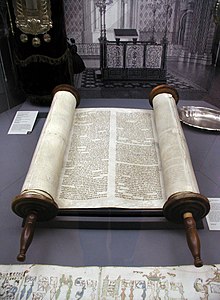
The Onetime Attestation and New Testament of the Bible both contain statements that God cannot lie and that lying is immoral (Num. 23:19,[60] Hab. 2:three,[61] Heb. vi:13–xviii).[62] Nevertheless, at that place are examples of God deliberately causing enemies to become disorientated and confused, in gild to provide victory (2 Thess. 2:11;[63] [64] ane Kings 22:23;[65] Ezek. 14:9).[66]
Various passages of the Bible feature exchanges that assert lying is immoral and wrong (Prov. 6:16–xix; Ps. 5:half dozen), (Lev. 19:eleven; Prov. 14:5; Prov. 30:6; Zeph. 3:xiii), (Isa. 28:15; Dan. 11:27), most famously, in the Ten Commandments: "Thou shalt non deport fake witness" (Ex. 20:2–17; Deut. 5:6–21); Ex. 23:1; Matt. 19:18; Mark 10:19; Luke 18:20 a specific reference to perjury.
Other passages feature descriptive (non prescriptive) exchanges where lying was committed in farthermost circumstances involving life and death, nevertheless, most Christian philosophers would argue that lying is never acceptable, simply that fifty-fifty those who are righteous in God's eyes sin sometimes. Sometime Testament accounts of lying include:[67]
- The midwives lied about their inability to impale the Israelite children. (Ex. 1:15–21).
- Rahab lied to the king of Jericho about hiding the Hebrew spies (Josh. 2:4–5) and was not killed with those who were disobedient because of her faith (Heb. 11:31).
- Abraham instructed his wife, Sarah, to mislead the Egyptians and say that she is his sis (Gen. 12:10). Abraham'southward story was strictly true – Sarah was his half sister – but intentionally misleading because it was designed to lead the Egyptians to believe that Sarah was not Abraham'southward married woman for Abraham feared that they would kill him in order to take her, for she was very beautiful.[68]
In the New Attestation, Jesus refers to the Devil as the father of lies (John 8:44) and Paul commands Christians "Exercise not lie to one another" (Col. 3:9; cf. Lev. 19:xi). In the Day of Judgement, unrepentant liars volition be punished in the lake of fire. (Rev. 21:8; 21:27).
Augustine'south taxonomy

Augustine of Hippo wrote two books virtually lying: On Lying (De Mendacio) and Against Lying (Contra Mendacio).[69] [seventy] He describes each volume in his later work, Retractationes. Based on the location of De Mendacio in Retractationes, it appears to accept been written about Advertizing 395. The first work, On Lying, begins: "Magna quæstio est de Mendacio" ("At that place is a great question about Lying"). From his text, information technology tin can be derived that St. Augustine divided lies into 8 categories, listed in social club of descending severity:
- Lies in religious educational activity
- Lies that harm others and help no ane
- Lies that harm others and help someone
- Lies told for the pleasure of lying
- Lies told to "please others in smoothen discourse"
- Lies that harm no one and that assistance someone materially
- Lies that harm no 1 and that assist someone spiritually
- Lies that harm no one and that protect someone from "bodily defilement"
Despite distinguishing betwixt lies according to their external severity, Augustine maintains in both treatises that all lies, defined precisely as the external communication of what one does non hold to be internally true, are categorically sinful and therefore, ethically impermissible.[71]
Augustine wrote that lies told in jest, or by someone who believes or opines the lie to be truthful are not, in fact, lies.[72]
In Buddhism
The fourth of the 5 Buddhist precepts involves falsehood spoken or committed to by action.[73] Avoiding other forms of wrong speech are also considered part of this precept, consisting of malicious speech, harsh speech communication, and gossip.[74] [75] A breach of the precept is considered more serious if the falsehood is motivated by an ulterior motive [73] (rather than, for example, "a small white lie").[76] The accompanying virtue is being honest and dependable,[77] [78] and involves honesty in work, truthfulness to others, loyalty to superiors, and gratitude to benefactors.[79] In Buddhist texts, this precept is considered almost important next to the kickoff precept, because a lying person is regarded to have no shame, and therefore capable of many wrongs.[fourscore] Lying is non only to be avoided because it harms others, but besides considering it goes against the Buddhist ideal of finding the truth.[76] [81]
The fourth axiom includes avoidance of lying and harmful speech.[82] Some modern Buddhist teachers such as Thich Nhat Hanh interpret this to include avoiding spreading false news and uncertain information.[80] Work that involves data manipulation, simulated advertising, or online scams tin also be regarded as violations.[83] Anthropologist Barend Terwiel reports that amid Thai Buddhists, the fourth axiom also is seen to exist broken when people insinuate, exaggerate, or speak abusively or deceitfully.[84]
In Norse paganism
In Gestaþáttr, one of the sections within the Eddaic poem Hávamál, Odin states that it is appropriate, when dealing with "a fake foe who lies", to tell lies besides.[85]
In Zoroastrianism
Zoroaster teaches that at that place are two powers in the universe; Asha, which is truth, order, and that which is real, and Druj, which is "the Lie". Later on, the Lie became personified as Angra Mainyu, a figure similar to the Christian Devil, who was portrayed every bit the eternal opponent of Ahura Mazda (God).
Herodotus, in his mid-fifth-century BC account of Persian residents of the Pontus, reports that Persian youths, from their fifth year to their twentieth year, were instructed in 3 things – "to ride a horse, to draw a bow, and to speak the Truth".[86] He further notes that:[86] "The most disgraceful thing in the world [the Persians] think, is to tell a prevarication; the next worst, to owe a debt: considering, among other reasons, the debtor is obliged to tell lies."
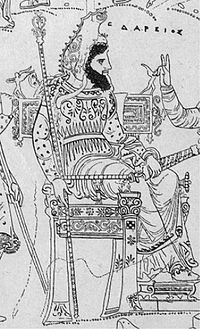
Darius I, imagined past a Greek painter, fourth century BCE
In Achaemenid Persia, the prevarication, drauga (in Avestan: druj), is considered to be a fundamental sin and information technology was punishable by death in some extreme cases. Tablets discovered by archaeologists in the 1930s [87] at the site of Persepolis give us adequate evidence well-nigh the love and veneration for the culture of truth during the Achaemenian menses. These tablets contain the names of ordinary Persians, mainly traders and warehouse-keepers.[88] According to Stanley Insler of Yale University, as many as 72 names of officials and petty clerks found on these tablets comprise the discussion truth.[89] Thus, says Insler, we take Artapana, protector of truth, Artakama, lover of truth, Artamanah, truth-minded, Artafarnah, possessing splendour of truth, Artazusta, delighting in truth, Artastuna, pillar of truth, Artafrida, prospering the truth, and Artahunara, having nobility of truth.
It was Darius the Not bad who laid down the "ordinance of good regulations" during his reign. Darius' testimony about his constant battle against the Lie is found in the Behistun Inscription. He testifies:[ninety] "I was not a lie-follower, I was not a doer of wrong ... According to righteousness I conducted myself. Neither to the weak or to the powerful did I do incorrect. The human who cooperated with my house, him I rewarded well; who so did injury, him I punished well."
He asks Ahuramazda, God, to protect the land from "a (hostile) ground forces, from dearth, from the Lie".[91]
Darius had his hands full dealing with large-calibration rebellion which broke out throughout the empire. After fighting successfully with 9 traitors in a twelvemonth, Darius records his battles against them for posterity and tells us how it was the Lie that made them rebel confronting the empire. At the Behistun inscription, Darius says: "I smote them and took prisoner 9 kings. I was Gaumata by proper noun, a Magian; he lied; thus he said: I am Smerdis, the son of Cyrus ... One, Acina by name, an Elamite; he lied; thus he said: I am male monarch in Elam ... One, Nidintu-Bel by name, a Babylonian; he lied; thus he said: I am Nebuchadnezzar, the son of Nabonidus. ... The Lie fabricated them rebellious, and so that these men deceived the people."[92] So advice to his son Xerxes, who is to succeed him as the great king: "1000 who shalt be king time to come, protect yourself vigorously from the Lie; the man who shall be a lie-follower, him do thou punish well, if thus m shall think. May my state be secure!"[ citation needed ]
Meet besides
- Appeal to emotion
- Blackness propaganda
- Confabulation
- Deception
- Disinformation
- Ethics
- Evasion (ideals)
- Fabrication (science)
- False analogy
- Fake equivalence
- Falsifiability
- Honesty
- Mental reservation
- Common deceit
- Plausible deniability
- Mail service-truth politics
- Prisoner'due south dilemma
- Propaganda
- Psychological manipulation
- Sophistry
- Spin (public relations)
- Traitor
- Truth
- Weasel give-and-take
References
- ^ Carson, Thomas L. (2012). Lying and charade : theory and practice. Oxford University Press. ISBN978-0199654802. OCLC 769544997.
- ^ Mahon, James Edwin (21 February 2008). "The Definition of Lying and Deception". Stanford Encyclopedia of Philosophy. Archived from the original on 18 March 2019. Retrieved 29 December 2018.
- ^ Mahon, James Edwin (2008). "Two Definitions of Lying". International Journal of Practical Philosophy. 22 (2): 211–230. doi:10.5840/ijap200822216. ISSN 0739-098X.
- ^ Meibauer, Jörg, ed. (fifteen Nov 2018). The Oxford Handbook of Lying. doi:10.1093/oxfordhb/9780198736578.001.0001. ISBN978-0198736578.
- ^ a b c Vrij, Aldert; Hartwig, Maria; Granhag, Pär Anders (iv January 2019). "Reading Lies: Nonverbal Advice and Deception". Almanac Review of Psychology. seventy (1): 295–317. doi:10.1146/annurev-psych-010418-103135. ISSN 0066-4308. PMID 30609913. S2CID 58562467. Retrieved eight December 2021.
- ^ a b Zimmerman, Laura (2016). "Deception detection". Monitor on Psychology. American Psychological Clan. 47 (3): 46. Retrieved 8 December 2021.
- ^ Brashier, Nadia M.; Marsh, Elizabeth J. (iv Jan 2020). "Judging Truth". Annual Review of Psychology. 71 (1): 499–515. doi:10.1146/annurev-psych-010419-050807. ISSN 0066-4308. PMID 31514579. S2CID 202569061. Retrieved ix December 2021.
- ^ "Worldwidewords.org". Worldwidewords.org. 13 June 2009. Archived from the original on 7 October 2010. Retrieved 10 July 2013.
- ^ a b c d due east f g h Dictionary.com Archived 21 April 2018 at the Wayback Auto. vii Dec 2017.
- ^ a b c ChangingMinds.org Archived 2020-xi-09 at the Wayback Machine. 9 November 2020.
- ^ Fu, Genyue; Evans, Angela D.; Wang, Lingfeng; Lee, Kang (July 2008). "Lying in the name of the commonage skilful: a developmental written report". Developmental Science. 11 (4): 495–503. doi:ten.1111/j.1467-7687.2008.00695.x. PMC2570108. PMID 18576957.
- ^ Frankfurt, Harry (two June 2013) [2005]. On Bullshit. Princeton, Due north.J.: Princeton Academy Printing. ISBN978-0691122946.
- ^ a b Ericsson, Stephanie (2010). Patterns for College Writing (11th ed.). St. Wartins: Bedford. p. 487. ISBN978-0312601522.
- ^ AllCott, Hunt and Matthew Gentzkow. "Social Media and Fake News in the 2016 Election." Archived 18 Oct 2017 at the Wayback Machine Stanford University. Spring 2017. 7 December 2017.
- ^ Druzin, Bryan (2011). "The Criminalization of Lying: Under what Circumstances, if any, should Lies be made Criminal?". Journal of Criminal Law and Criminology. 101: 548–fifty. Archived from the original on 5 October 2016. Retrieved 5 October 2016.
- ^ "Merriam Webster Definition of Half-truth, Baronial 1, 2007". M-west.com. 31 Baronial 2012. Archived from the original on 23 December 2007. Retrieved ten July 2013.
- ^ Cavinder, Fred D. (1985). The Indiana Book of Records, Firsts, and Fascinating Facts. p. 104. ISBN0253283205.
- ^ Murphy, Kirk, Memorial Day Retentivity Hole: After Israel Forgets "Exodus", White Firm Forgets "Shores of Tripoli". Volition Obama Remember NATO? Archived i November 2014 at the Wayback Machine 31 May 2010 Firedoglake.com
- ^ Weinstein, Adam, Nevada Tea Partier's Memory Hole, 9 June 2010 Archived 31 January 2017 at the Wayback Automobile. Mother Jones.
- ^ Guerrero, L., Anderson, P., Afifi, Due west. (2007). Close Encounters: Communication in Relationships (2d ed.). Los Angeles: Sage Publications.
- ^ Minkler, Alanson (2011). Integrity and Understanding: Economics When Principles Also Matter. Ann Arbor, Michigan: University of Michigan Press. pp. 78, 128. ISBN978-0472116430.
- ^ a b Arp, Robert (2013). Psych and Philosophy. Chicago: Open Courtroom Publishing. p. 140. ISBN978-0812698251.
- ^ Aruffo, Madeline. "Bug with the Noble Lie." Archived 17 May 2017 at the Wayback Machine Boston Academy. Accessed 4 December 2017.
- ^ Gerdeman, Dina (five December 2016). "How To Deceive Others With Truthful Statements (It'due south Called 'Paltering,' And It's Risky)". HBS Working Knowledge . Retrieved 18 November 2021.
{{cite web}}: CS1 maint: url-status (link) - ^ a b Dike CC, Baranoski M, Griffith EE (2005). "Pathological lying revisited". The Journal of the American Academy of Psychiatry and the Law. 33 (3): 342–349. PMID 16186198. Archived from the original on 13 Jan 2013. Retrieved 6 July 2014.
- ^ a b c Dike, Charles C. (ane June 2008). "Pathological Lying: Symptom or Disease?". Psychiatric Times. Vol. 25, no. 7. Archived from the original on 8 March 2011. Retrieved 6 July 2014.
- ^ "Butler Lie term coined at Cornell University". News.cornell.edu. 20 December 2010. Archived from the original on 28 October 2012. Retrieved ten July 2013.
- ^ Beatty, Jeffrey; Samuelson, Susan (13 March 2007). Cengage Reward Books: Essentials of Business concern Constabulary. p. 293. ISBN978-0324537123.
- ^ Niles' Register, thirteen June 1829
- ^ Transactions of the New York Country Agricultural Society, Vol 19, 1859, p. 230.
- ^ Microsoft Encarta, "weasel words Archived iv June 2011 at the Wayback Machine"
- ^ "Definition of 'white lie'". Lexico. Archived from the original on 18 April 2020. Retrieved 12 March 2020.
- ^ "White lie". Archived from the original on 5 September 2019. Retrieved 12 March 2020.
- ^ "Definition of 'white lie'". dictionary.com. Archived from the original on 28 October 2019. Retrieved 12 March 2020.
- ^ Timasheff, Nicholas Sergeyevitch. "An Introduction to the Sociology of Law." Google Books. 7 December 2017.
- ^ Arendt, Hannah. "Hannah Arendt: From an Interview." Archived 1 December 2017 at the Wayback Car The New York Review of Books. 26 Oct 1978 issue. 30 November 2017.
- ^ Seigel, Jessica (25 March 2021). "The truth about lying". Knowable Magazine. doi:10.1146/knowable-032421-1 . Retrieved 8 Dec 2021.
- ^ Conti, Alli. "Are Lie Detector Tests Complete Bullshit?" Archived viii December 2017 at the Wayback Machine VICE. 17 Nov 2014. 7 December 2017.
- ^ Williams, Emma J.; Lewis A. Bott; John Patrick; Michael B. Lewis (three Apr 2013). "Telling Lies: The Irrepressible Truth?". PLOS ONE. eight (four): e60713. Bibcode:2013PLoSO...860713W. doi:10.1371/journal.pone.0060713. PMC3616109. PMID 23573277.
- ^ a b Roy Britt, "Lies Take Longer Than Truths," LiveScience.com, 26 Jan 2009, found at [ane] Archived 3 July 2012 at the Wayback Auto. Accessed 27 November 2011.
- ^ a b Arjuna, T. "To lead a life of lies". Can we talk? by T. Arjuna. Sunday Observer. Archived from the original on 11 February 2012. Retrieved 10 July 2012. | Sri Lanka's Sunday Observer article on lying, February 2012
- ^ How to Make Good Decisions and Be Right All the Fourth dimension, (2008), Iain Male monarch, p. 148.
- ^ "Why We Cheat". Think! (Podcast). KERA. 17 Nov 2021. (around 5:00)
- ^ How to Make Good Decisions and Be Right All the Time, (2008), Iain King, p. 147.
- ^ "Deceiver's Distrust: Denigration as a Outcome of Undiscovered Deception", (1998), Brad J. Sagarin, Kelton v. L. Rhoads, Robert B. Cialdini.
- ^ Hanley, Elizabeth (4 July 2004). "Listening to Koko" (PDF). Commonweal Magazine: 16. Archived (PDF) from the original on fourteen July 2014. Retrieved vii July 2014.
- ^ "Killdeer" Archived 28 June 2011 at the Wayback Automobile. Ohio Department of Natural Resources. Retrieved 1 March 2011.
- ^ "Guide to Washington Post Fact Checker Rating Scale". Voices.washingtonpost.com. 29 December 2011. Archived from the original on 30 November 2011. Retrieved 3 January 2012.
- ^ 1620 T. Shelton tr. Cervantes' Don Quixote ii. xxi. Love and warre are all one. It is lawfull to use sleights and stratagems to attaine the wished cease.
- ^ 1578 Lyly Euphues I. 236 Anye impietie may lawfully exist committed in loue, which is lawlesse.
- ^ Machiavelli, Niccolo, The Prince, Chap. 18
- ^ Bhattacharjee, Yudhijit. "Why We Lie: The Science Behind Our Deceptive Ways." Archived vii Dec 2017 at the Wayback Machine National Geographic.
- ^ "What is Darwin's Theory of Evolution?". LiveScience.com. Archived from the original on two October 2015. Retrieved 12 October 2015.
- ^ "Why Do We Lie?". Psychology Today . Retrieved 12 October 2015.
- ^ a b Smith, David Livingstone. "Natural-Born Liars".
- ^ Abe, N.; Fujii, T.; Hirayama, K.; Takeda, A.; Hosokai, Y.; Ishioka, T.; Nishio, Y.; Suzuki, K.; Itoyama, Y.; Takahashi, Due south.; Fukuda, H.; Mori, East. (2009). "Do parkinsonian patients have trouble telling lies? The neurobiological basis of deceptive behaviour". Encephalon. 132 (v): 1386–95. doi:10.1093/brain/awp052. PMC2677797. PMID 19339257.
- ^ "Merriam–Webster.com". Merriam-webster.com. 31 August 2012. Archived from the original on xix February 2010. Retrieved 10 July 2013.
- ^ "People.tribe.cyberspace". People.tribe.cyberspace. 19 August 2007. Archived from the original on thirty May 2013. Retrieved x July 2013.
- ^ Grieve, Rachel; Hayes, Jordana (1 January 2013). "Does perceived ability to deceive = ability to deceive? Predictive validity of the perceived ability to deceive (PATD) scale". Personality and Individual Differences. 54 (2): 311–14. doi:10.1016/j.paid.2012.09.001.
- ^ "Num. 23:xix". Biblegateway.com. Archived from the original on 11 July 2019. Retrieved 10 July 2013.
- ^ "Hab. two:3". Bible.cc. Archived from the original on 14 August 2011. Retrieved 10 July 2013.
- ^ "Heb vi:thirteen–18". Soundofgrace.com. 10 November 1996. Archived from the original on 17 October 2010. Retrieved 10 July 2013.
- ^ "2 Thess. 2:eleven". Biblegateway.com. Archived from the original on 23 November 2018. Retrieved 10 July 2013.
- ^ "2 Thess. two:11". Biblegateway.com. Archived from the original on 23 Nov 2018. Retrieved 10 July 2013.
- ^ "1 Kings 22:23". Bible.cc. Archived from the original on 15 May 2011. Retrieved 10 July 2013.
- ^ "Ezek. 14:9". Bible.cc. Archived from the original on 22 November 2011. Retrieved 10 July 2013.
- ^ Come across also: O'Neill, Barry. (2003). "A Formal System for Understanding Lies and Deceit." Archived 28 February 2008 at the Wayback Automobile Revision of a talk for the Jerusalem Briefing on Biblical Economic science, June 2000.
- ^ "Genesis 12:11 – "When he was near to enter Egypt, he said to Sarai his married woman, 'I know that you are a woman'"". ESVBible.org. Retrieved 10 July 2013.
- ^ Saint Augustine (2002). Deferrari, Roy J. (ed.). Treatises on diverse subjects. Translated by Mary Sarah Muldowney (1st pbk. reprint. ed.). New York: Cosmic University of America Press. ISBN978-0813213200. Archived from the original on iii Feb 2017. Retrieved 3 Feb 2016.
- ^ Schaff, Philip (1887). A Select Library of the Nicene and Post-Nicene Fathers of the Christian Church: St. Augustin: On the Holy Trinity. Doctrinal treatises. Moral treatises. The Christian Literature Visitor.
- ^ "Church Fathers: On Lying (St. Augustine)". Archived from the original on 26 September 2010. Retrieved thirty December 2016.
- ^ Imre, Robert; Mooney, T. Brian; Clarke, Benjamin (2008). Responding to terrorism: political, philosophical and legal perspectives ([Online-Ausg.] ed.). Aldershot, Hampshire, England: Ashgate. ISBN978-0754672777. Archived from the original on 3 February 2017. Retrieved 3 Feb 2016.
- ^ a b Leaman, Oliver (2000). Eastern Philosophy: Cardinal Readings (PDF). Routledge. p. 140. ISBN978-0-415-17357-v. Archived (PDF) from the original on 8 August 2017.
- ^ Segall, Seth Robert (2003). "Psychotherapy Practice as Buddhist Exercise". In Segall, Seth Robert (ed.). Encountering Buddhism: Western Psychology and Buddhist Teachings. Land University of New York Press. p. 169. ISBN978-0-7914-8679-v.
- ^ Harvey 2000, pp. 74, 76.
- ^ a b Harvey 2000, p. 75.
- ^ Cozort, Daniel (2015). "Ethics". In Powers, John (ed.). The Buddhist World. Routledge. ISBN978-1-317-42016-3.
- ^ Harvey 2000, p. 68.
- ^ Wai 2002, p. 3.
- ^ a b Harvey 2000, p. 74.
- ^ Wai 2002, p. 295.
- ^ Powers, John (2013). A Concise Encyclopedia of Buddhism. Oneworld Publications. ISBN978-1-78074-476-6.
- ^ Johansen, Barry-Craig P.; Gopalakrishna, D. (21 July 2016). "A Buddhist View of Adult Learning in the Workplace". Advances in Developing Human Resources. viii (iii): 342. doi:10.1177/1523422306288426. S2CID 145131162.
- ^ Terwiel, Barend Jan (2012). Monks and Magic: Revisiting a Classic Study of Religious Ceremonies in Thailand (PDF). Nordic Institute of Asian Studies. p. 183. ISBN9788776941017. Archived (PDF) from the original on nineteen August 2018.
- ^ "VTA.gamall-steinn.org". VTA.gamall-steinn.org. Archived from the original on 12 September 2005. Retrieved ten July 2013.
- ^ a b Herodotus (2009) [publication appointment]. The Histories. Translated past George Rawlinson. Digireads.Com. pp. 43–44. ISBN978-1420933055.
- ^ Garrison, Mark B.; Root, Margaret C. (2001). Seals on the Persepolis Fortification Tablets, Volume one. Images of Heroic Run into (OIP 117) . Chicago: Online Oriental Institute Publications. Archived from the original on v January 2007. Retrieved ix January 2007.
- ^ Dandamayev, Muhammad (2002). "Persepolis Elamite Tablets". Encyclopedia Iranica. Archived from the original on 21 January 2012. Retrieved i November 2013.
- ^ Insler, Stanley (1975). "The Honey of Truth in Ancient Islamic republic of iran". Archived from the original on v May 2007. Retrieved nine Jan 2007. In Insler, Stanley; Duchesne-Guillemin, J., eds. (1975). The Gāthās of Zarathustra (Acta Iranica 8). Liege: Brill.
- ^ Brian Carr; Brian Carr; Indira Mahalingam (1997). Companino Encyclopedia of Asian philosophy. Taylor & Francis. ISBN978-0415035354.
- ^ DPd inscription, lines 12–24: "Darius the Rex says: May Ahuramazda behave me aid, with the gods of the royal business firm; and may Ahuramazda protect this country from a (hostile) army, from famine, from the Prevarication! Upon this country may there not come an army, nor famine, nor the Lie; this I pray as a boon from Ahuramazda together with the gods of the royal house. This boon may Ahuramazda together with the gods of the royal house requite to me! "
- ^ "Darius, Behishtan (DB), Column i". Archived from the original on 19 July 2017. Retrieved 27 July 2015. From Kent, Roland Thousand. (1953). Erstwhile Persian: Grammer, texts, dictionary. New Haven: American Oriental Society.
Sources
- Harvey, Peter (2000), An Introduction to Buddhist Ideals: Foundations, Values and Issues (PDF), Cambridge Academy Printing, ISBN978-0-511-07584-1, archived from the original (PDF) on 12 April 2019, retrieved 24 August 2018
- Wai, Maurice Nyunt (2002), Pañcasila and Cosmic Moral Educational activity: Moral Principles as Expression of Spiritual Experience in Theravada Buddhism and Christianity, Gregorian Biblical BookShop, ISBN9788876529207
Further reading
- Adler, J.E. "Lying, deceiving, or falsely implicating," Journal of Philosophy, Vol. 94 (1997), 435–52.
- Aquinas, T., St. "Question 110: Lying," in Summa Theologiae (II.Ii), Vol. 41, Virtues of Justice in the Man Community (London, 1972).
- Augustine, St. "On Lying" and "Against Lying," in R.J. Deferrari, ed., Treatises on Various Subjects (New York, 1952).
- Bok, S. Lying: Moral Choice in Public and Individual Life, 2d ed. (New York, 1989).
- Carson, Thomas L. (2006). "The Definition of Lying". Nous. twoscore (2): 284–306. doi:10.1111/j.0029-4624.2006.00610.x. S2CID 143729366.
- Chisholm, R.Thou.; Feehan, T.D. (1977). "The intent to deceive". Periodical of Philosophy. 74 (3): 143–59. doi:ten.2307/2025605. JSTOR 2025605.
- Davids, P.H.; Bruce, F.F.; Brauch, K.T. & Due west.C. Kaiser, Hard Sayings of the Bible (InterVarsity Printing, 1996).
- Denery II, Dallas M. The Devil Wins: A History of Lying From the Garden of Eden to the Enlightenment (Princeton University Press; 2014) 352 pages; Uses religious, philosophical, literary and other sources in a study of lying from the perspectives of God, the Devil, theologians, courtiers, and women.
- Fallis, Don (2009). "What is Lying?". Journal of Philosophy. 106 (one): 29–56. doi:x.5840/jphil200910612. SSRN 1601034.
- Frankfurt, H.Chiliad. "The Faintest Passion," in Necessity, Volition and Beloved (Cambridge, MA: Loving cup, 1999).
- Hausman, Carl, "Lies Nosotros Alive Past," (New York: Routledge, 2000).
- Kant, I. Groundwork of the Metaphysics of Morals, The Metaphysics of Morals and "On a supposed right to lie from philanthropy," in Immanuel Kant, Practical Philosophy, eds. Mary Gregor and Allen West. Wood (Cambridge: Loving cup, 1986).
- Lakoff, George, Don't Call back of an Elephant, (Chelsea Green Publishing, 2004).
- Leslie I. Born Liars: Why We Can't Alive Without Deceit (2011)
- Mahon, J.E. "Kant on Lies, Candour and Reticence," Kantian Review, Vol. vii (2003), 101–33.
- Mahon, J.E., "Lying," Encyclopedia of Philosophy, 2d ed., Vol. v (Farmington Hills, MI: Macmillan Reference, 2006), 618–19.
- Mahon, J.E. "Kant and the Perfect Duty to Others Not to Lie," British Periodical for the History of Philosophy, Vol. fourteen, No. four (2006), 653–85.
- Mahon, J.E. "Kant and Maria von Herbert: Reticence vs. Deception," Philosophy, Vol. 81, No. iii (2006), 417–44.
- Mannison, D.S. "Lying and Lies," Australasian Periodical of Philosophy, Vol. 47 (1969), 132–44.
- Maugh Ii, Thomas H. (1 April 1991). "Science / Medicine : The Lies That Bind: Well-nigh All Species Deceive : Life: Deception is not only useful, experts say, it is often a necessity that allows organisms to survive". Los Angeles Times . Retrieved xi March 2021.
- Mount, Ferdinand, "Ruthless and Truthless" (review of Peter Oborne, The Assault on Truth: Boris Johnson, Donald Trump and the Emergence of a New Moral Atrocity, Simon and Schuster, February 2021, ISBN 978 1 3985 0100 3, 192 pp.; and Colin Kidd and Jacqueline Rose, eds., Political Advice: By, Present and Future, I.B. Tauris, February 2021, ISBN 978 1 83860 004 4, 240 pp.), London Review of Books, vol. 43, no. ix (half-dozen May 2021), pp. 3, 5–8.
- Siegler, F.A. "Lying," American Philosophical Quarterly, Vol. iii (1966), 128–36.
- Sorensen, Roy (2007). "Bald-Faced Lies! Lying Without the Intent to Deceive". Pacific Philosophical Quarterly. 88 (2): 251–64. doi:10.1111/j.1468-0114.2007.00290.x.
- Stokke, Andreas (2013). "Lying and Asserting". Periodical of Philosophy. 110 (ane): 33–60. doi:10.5840/jphil2013110144. SSRN 1601034.
- Margaret Talbot (2007). "Duped. Tin can encephalon scans uncover lies?". The New Yorker, two July 2007.
External links
Source: https://en.wikipedia.org/wiki/Lie
0 Response to "Its a Lie"
Post a Comment