Japanese Women Teaching Each Other Graphic Art Red White Black
Japanese Art: Everything You Might Not Know
Japanese Art: Everything You lot Might Non Know
by Nippon Objects | Updated June 2021 | Fine art
Mount Fuji by Yokoyama Taikan, 1940
Japanese art is one of the world's greatest treasures, only information technology is also surprisingly hard to detect upwards-to-appointment information on the net.
This ultimate guide will innovate the almost inspiring aspects of Japanese art: from the oldest surviving silkscreen painting, through magnificent 18th century woodblock prints, to Nippon's most famous modern creative person Yayoi Kusama.
Fine art is created by people. That'due south why, in telling these stories, nosotros pay close attending to their social and political implications. Through these 10 newly updated capacity you will acquire, for instance, why nature has ever been central to the Japanese style of life, and how the Edo era produced some of the nearly exquisite paintings of cute women.
The Japanese gimmicky art scene is buzzing with innovation and creativity. We are pleased to share with yous some of the about ingenious contemporary artists, craftswomen and men, who are often non as well-known internationally as they should exist.
Let's dive correct in!
one. The Origins of Japanese Art
Great Wave off Kanagawa, Woodblock Impress past Katsushika Hokusai
The Great Moving ridge off Kanagawa by Katsushika Hokusai (1760-1849) is undoubtedly one of the most famous Japanese artworks. It is no coincidence that this much-loved woodblock print has equally its theme the formidable power of nature, and that it contains the regal Mount Fuji.
Nature, and specifically mountains, have been a favorite subject of Japanese fine art since its earliest days. Before Buddhism was introduced from Mainland china in the 6th century, the religion known today as Shinto was the sectional faith of the Japanese people. At its core, Shinto is the reverence for the kami, or deities, who are believed to reside in natural features, such as copse, rivers, rocks, and mountains. To learn more about the Shinto organized religion, check out What are Shinto Shrines!
In Japan, therefore, nature is non a secular subject. An epitome of a natural scene is not but a landscape, but rather a portrait of the sacred world, and the kami who alive inside it. The centrality of nature throughout Japanese art history endures today, meet for case these v Authentic Japanese Garden Designs.
This veneration for the natural world would take on many layers of new significant with the introduction of Chinese styles of art – along with many other aspects of Chinese culture – throughout much of the first millennium.
Senzui Byobu, Mural Screen, 12th century, Kyoto National Museum
This meticulous Heian-era (794-1185) painting is the oldest surviving Japanese silk screen, an fine art course itself developed from Chinese predecessors (and enduring until today, see here for the Creative Features of the Japanese House). The manner is recognizably Chinese, but the mural itself is Japanese. Afterward all the artist would probably never take been to People's republic of china himself.
Painting of a Cypress by Kano Eitoku, 16th Century, Tokyo National Museum
The creation of an contained Japanese art style, known as yamato-e (literally Japanese pictures), began in this fashion: the gradual replacement of Chinese natural motifs with more than common homegrown varieties. Japanese long-tail birds were often substituted for the ubiquitous Chinese phoenix, for example, while local copse and flowers took the identify of unfamiliar foreign species. I animal that is oftentimes seen in Japanese art is the kitsune, or play a joke on. Here are some other Things You Should Know nigh the Inari Trick in Japanese Folklore! Themes of Japanese literature and mythology began to predominate. Classic stories such every bit the Tale of Genji can be seen throughout Japanese art, equally you tin can capeesh in these 10 Must See Masterpieces.
Equally direct links with Mainland china dissipated during the Heian menses, yamato-east became an increasingly deliberate statement of the supremacy of Japanese art and culture. Zen, another Chinese import, was developing into a rigorous philosophical organisation, which began to make its mark on all forms of traditional Japanese fine art. To learn more, meet What is Zen Fine art? An Introduction in ten Japanese Masterpieces.
View of Ama no Hashidate, Ink Painting past Sesshu Toyo, 1501, Kyoto National Museum
Zen monks took especially to ink painting, sumi-e , reflecting the simplicity and importance of empty space central to both art and faith. I of the greatest masters of the form, Sesshu Toyo (1420-1506), demonstrates the innovation of Japanese ink painting in View of Ama no Hashidate, past painting a bird'south eye view of Nippon's spectacular coastal landscape. Sumi-e continues to be one of Japanese most popular artforms. Yous tin give it a go yourself with our How-to Guide to Japanese Ink Painting.
Suruga Street, Woodblock Print by Utagawa Hiroshige
Possibly cypher is as spectacular as the peachy Mount Fuji however. The perfect conical shape of the slumbering volcano, and the very real threat of its deadly fury, combine in an awe-inspiring entity that has been worshipped, and painted for centuries. You can see some examples over at Views of Mountain Fuji: Woodblock Prints Demystified.
2. Zen & The Tea Ceremony
The evolution of the tea anniversary had a profound influence on the history of Japanese art and arts and crafts. Well-to-do families had long taken the opportunity of social occasions to show off their most sumptuous Chinese tea implements, but this began to change in the 16th century, when aesthetes began to gravitate towards a simpler style.
The popularity of humbly decorated, unpolished, and almost significantly Japanese tea implements (what are the Essential Japanese Tea Anniversary Utensils?) began as a trend. It was transformed into a permanent fixture of the Japanese pattern mural through the endorsement of political ability, in particular armed services leader Toyotomi Hideyoshi (1537-1598) and his tea primary Sen Rikyu (1522-1591).
The style of craft which Rikyu favored has come to be known equally wabi-sabi . The zen-derived concept, while hard to interpret exactly, refers to a philosophy of imperfection and impermanence. Wabi-sabi tin can be seen in the preference for understated world tones over glittering painted colors for example, and for the irregular shapes of hand-molded ceramics over the perfection of cycle-thrown pots.
The popularity of the tea ceremony proved a bracing economic stimulus to Japanese craft, and through the centuries of Edo peace following Rikyu's fourth dimension, the wabi-sabi aesthetic spread to the cloth, incense , metalware, woodwork and ceramic industries, among others, all eager to supply the finest in Japanese design to their tea practising clients. Read more near Tetsubin Tea Ketttles, Kyusu Teapots and Ikebana Flower Organization to acquire how tea ceremony artefacts are used. Many of these craft skills are also put to good use in everyday life in Japan's ingenious bento boxes and traditional dolls.
3. The Art of the Samurai
People tend to acquaintance Japan with the venerable samurai warrior, only many people may not realize that these skilled fighters were trained in more than only combat.
Samurai (likewise known every bit bushi) were the warrior class of premodern Japan — their heyday was during the Edo menses (1603-1867). Samurai led their lives according to a carefully crafted lawmaking of ethics known as bushido (the mode of the warrior).
As the highest caste of the social bureaucracy, samurai were expected to be cultured and literate in improver to powerful and mortiferous. Because they served the wealthy nobility, who highly valued artistic pursuits, samurai warriors also arcadian the arts and aspired to become skilled in them.
Samurai were expected to follow both bu and bun – the arts of war and civilisation. There is even an expression for this lifestyle, bunbu-ryodo, which means literary arts, military arts, both ways.
Miyamoto Musashi by Utagawa Kunisada, 1858
Information technology's no surprise, then, that many samurai used their wealth and status to become poets, artists, collectors, sponsors, or all the above. Miyamoto Musashi (c. 1584-1645) is a perfect example of this Renaissance human being approach — he was a swordsman, strategist, philosopher, painter, and author in 1. He authored the famous Book of Five Rings, which argues that a true warrior makes mastery of many art forms besides that of the sword, such as tea drinking, writing, and painting.
An Actor Posing in Samurai Armor, 1870s
Women could vest to the samurai class likewise. Primarily they served as spouses to warriors, merely they could likewise railroad train and fight as warriors themselves. These female fighters were called onna-bugeisha. Female warriors typically just took up artillery in times of demand, for instance to defend their household during wartime. Nonetheless, some fought full-time and rose to prominence on their own.
Tomoe Gozen by Shitomi Kangetsu, Late 18th Century
Ane such warrior was Tomoe Gozen (c. 1157-1247), a onna-bugeisha immortalized in The Tale of the Heike. According to the ballsy, she was cute and powerful, possessing the strength of many, "a warrior worth a one thousand, ready to face a demon or a god." Though her existence is attributed to mere legend, warriors were inspired by her valor and she has been the subject of endless kabuki plays and ukiyo-e paintings alike.
© The Trustees of the British Museum, Katana by Osafune Sukesada
Samurai art directly related to gainsay includes the blueprint and craftsmanship of armor and weapons. Samurai swords, the main tool and symbol of the bushi, are renowned for their craftsmanship to this twenty-four hours, while the descendants of samurai swordsmiths are today producing some of the earth's most highly valued knives. Katana were strong yet flexible, with curved steel blades sporting a single, sharp cutting edge.
To separate the handle from the blade was the tsuba, which was evolved from a apparently metallic disk into the sheet for some of the most intricate metalwork. Family crests, auspicious symbols, and even whole scenes from myth and literature were carved into these elegant accessories. Similarly the netsuke was originally a practical necktie to concur a pouch on a belt, but evolved into an elaborately decorated piece of work of fine art as you will see in these fourteen Miniature Japanese Masterpieces!
Samurai armor was equally impressive and intricate. Information technology was expertly crafted past paw and fabricated of materials we may consider opulent, such equally lacquer for weather-proofing and leather (and eventually silk lace) to connect the individual scales. Facial armor was as well an intricate art in its own right; you lot tin read more than at 10 Things You lot Might Not Know About Traditional Japanese Masks. Even during times of peace, samurai continued to wear or display armor as a symbol of their status.
4. Edo Beauty in Ukiyo-east Prints
Iii Famous Beauties, Woodblock Print by Kitagawa Utamaro
The Edo era (1615-1868) enjoyed a long period of extraordinary stability. Edo society was booming and cities expanded on an unprecedented scale. Social classes were strictly enforced. At the top there was the samurai who served the Tokugawa regime, then the farmers and the artisans, finally at the lesser of the rank were the merchants.
Still, it was often the merchants who benefited the nigh economically due to their role equally distributors and service providers. Together with the artisans, they were known every bit the chonin (townspeople).
With new prosperity, goods of all kinds flourished. In particular woodblock prints, ukiyo-e, reached their apex in popularity and sophistication.
Ukiyo-e literally means pictures of the floating world. In its Edo context, these stunning woodblock prints highlighted the cultivated urban lifestyle, fashionability and the beauty of imperceptible.
Heron Maiden, Woodblock Print by Kitagawa Utamaro
It was also during this time that printing techniques became highly advanced. The production of woodblock prints was handled by what was and so called a ukiyo-e quartet. It included the publisher, who managed the enterprise, the blockcutter, the printer and the artist. By the 1740s, ukiyo-eastward fine art prints were already being made in multiple vivid colors. Some other important characteristic of these prints is the materials that they use, specifically washi newspaper, which you tin find out more than about at All Yous Need to Know About Washi Paper.
Scene of the Temporary Quarters of the New Yoshiwara, Woodblock Print by Utagawa Kunisada, 1830
I of the most important purposes of ukiyo-eastward prints was to reflect the stylish lifestyles of the Edo urbanites. Merchants were confined by constabulary to their social condition and equally a event, those with the means spent their time in pursuit of pleasure and luxury, such every bit could be found at the Yoshiwara pleasure district.
Brandish Room in Yoshiwara at Night, by Katsushika Oi, 1840s
Yoshiwara was more than just a brothel; it was a cultural hub for the rich and connected men of the Edo era. This scene vividly demonstrates the fascination with the area, both for those attending, and those who could only sentry from the outside. This contrast is made all the more poignant here in this piece of work by the brilliant Katsushika Oi, daughter of the more famous Hokusai. Fifty-fifty today, this incredible artist continues to be pushed to the margins. Read her story in Katsushika Oi: The Subconscious Hand of Hokusai's Daughter.
The courtesans of Yoshiwara were stunningly portrayed in ukiyo-e prints. Their lavish kimono, hairstyles and make-upwards were painstakingly brought to life. They were the stars of the Edo, and through these relatively cheap and widely distributed prints their every move was followed religiously by the townspeople in their normal lives.
Dazzler, Woodblock Print by Kitagawa Utamaro
Cooling off at Shijo, Woodblock Impress past Tsukioka Yoshitoshi, 1885
Kabuki theater was another popular bailiwick of ukiyo-east in the class of yakusha-e (player prints). Images of top-billing actors were often reproduced, and the prints frequently captured theatrical scenes with astonishing artistry and detail. You lot tin discover out more near Japanese theater in our essential guides to Kabuki, Noh and Bunraku Theater! For more examples of yakusha-e from print artist Tsukioka Yoshitoshi, you can read The Stories Behind the 100 Aspects of the Moon.
Pleasance Boat, Woodblock Impress by Toyohara Chikanobu, 1880s-90s
One of the more famous ukiyo-eastward artists of the time Toyohara Chikanobu, has for some reason get somewhat obscure outside of Japan today. He remains, however, 1 of the near collected woodblock artists domestically. To enjoy his sensational bijinga prints, take a expect at Who Was Chikanobu?
v. Traditional Japanese Architecture
Gion Shirakawa Culvert in Kyoto
Japanese Compages is frequently noted for its display of extreme oppositions and contradictions, whether it's the sprawling grounds of the Imperial Palace in Tokyo or the intimate scale of the traditional Japanese teahouse. Peradventure near widely recognized as distinctly Japanese is the residential architecture of the Edo flow, of which many examples survive today.
Nippon is known for having some of the oldest wooden buildings in the world. The apply of wood as a source textile in Japanese housing is widespread. This approach embodied both a spiritual and practical application. Due to Nihon'south frequent natural disasters, similar earthquakes and typhoons, builders sought to employ wood as it was resistant to button and pull. In contrast to Western houses, wooden Japanese structures were never painted over, leaving the grain visible as a fashion of showing respect for its natural value.
© 2019 Periplus Editions (HK) Ltd.
One chemical element of the traditional Japanese house that remains popular today is the unique flooring of the tatami mats. Historically, wealthier families afforded tightly woven tatami made of rush, while poorer families used mats fabricated of harbinger. Every bit whatever visitor to Japan knows, you are expected to remove your shoes earlier walking on Japanese tatami mat, or indeed in any Japanese home whatever the floor! Tatami are platonic for Japan'due south humid climate, equally they can blot water in the air which will efficiently evaporate on a dry out day.

The delicate wooden or bamboo framework of shoji, which are screens or room dividers, are both functional and creative in nature. The elegance of this traditional Japanese housing element is found in the low-cal that shines through its translucent newspaper ( washi ), creating atmospheric shadows within a home. Some shoji are painted on, and others maintain their traditional white facade. You lot tin can learn more about shoji screens and the elaborate kumiko woodwork that is used to make them.
© 2019 Periplus Editions (HK) Ltd.
From the outside of a Edo-era Japanese habitation, you lot tin usually notice that it is raised up off the basis in an attempt to prevent pelting harm. Additionally, instead of using nails, Japanese wooden structures were congenital with a supporting block system called tokyo, in which the pieces fit together naturally.

Surrounding the outside of a traditional Japanese home is a porch-like veranda called an engawa. Though part of the home, the engawa exists as a span, connecting the inside and the outside worlds. The relationship between shoji and engawa is poetic and playful, shoji and fusama maintaining the roles of opening and closing the house to light, shadows, and air from the exterior. Every bit seen in Hamarikyu gardens in Tokyo, the teahouse engawa plays an important role in the relationship between indoor and outdoor. To get a better sense of the layout of a traditional Japanese home take a tour Within 5 Timeless Traditional Japanese Houses.
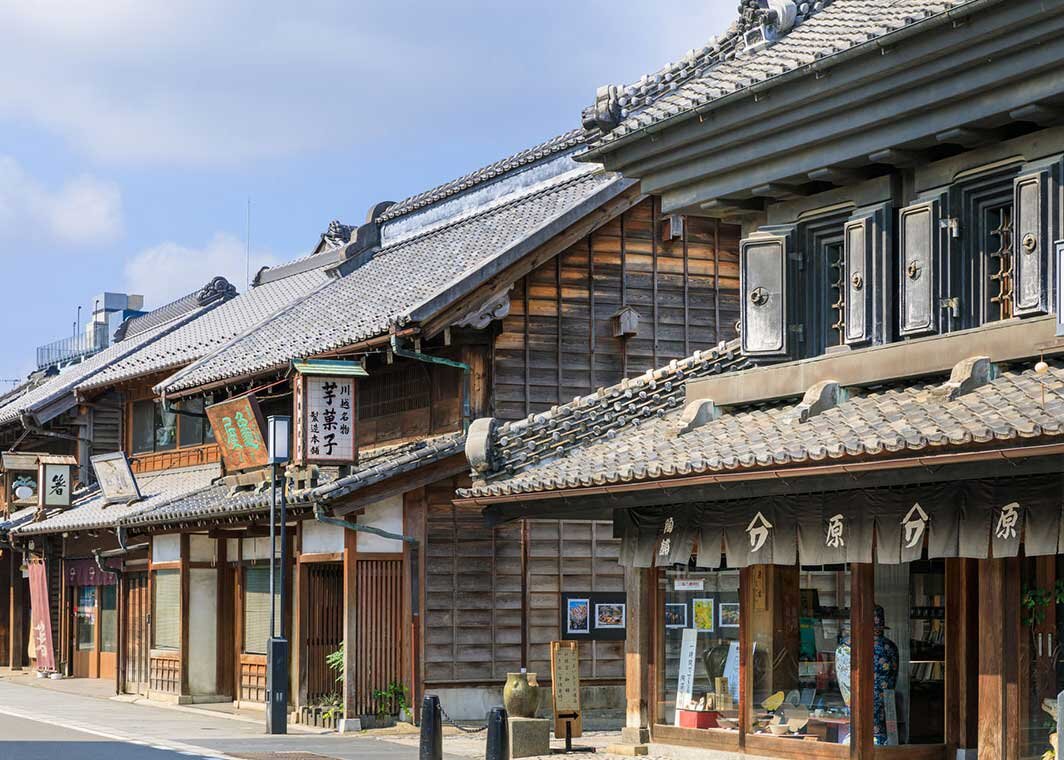
A look at the fire resistant structures known as kura-zukuri in the Kawagoe district brings one back to the Edo menstruation. Also known equally "Little Edo," Kawagoe was well known for its prosperous merchandise. Unfortunately, the small-scale town endured devastating fires and ruin in the 1800'southward. Thus began its rebuilding with clay-walled warehouses to prevent further damage.
The famous gassho-zukuri farmhouses found in Shirakawa-become are excellent examples of traditional Japanese architecture. Literally translating to "Built similar hands in prayer," gassho-zukuri is a thatched roof architectural fashion developed to tolerate heavy snowfall in winter. The nature of the space created with the A-frame technique allows for a large attic expanse for raising silkworms. The gassho-zukuri farmhouses that extend from Gifu to Toyama Prefecture have now become a UNESCO world heritage site, and are certainly 1 of the 10 Best Towns to Savour the Wintertime Snow in Nippon.

As if withdrawing from the simplistic and ascetic garden pattern of the Momoyama period that preceded information technology, the Edo period brought with it a sense of garden extravagance for those in the upper echelons of society. "Strolling gardens," gardens made for long, peaceful, fifty-fifty meditative walks, were congenital with bogus hills, ponds, and an abundance of natural elements such as plants, and bamboo. Although these strolling gardens were initially constructed for feudal lords' private homes, the Meiji menstruation shifted the boundary from private to public. This tin can be seen in Kyoto at the Katsura Majestic Villa. A garden made with the mentality to notice the space non inhabit it. If you're interested, have a await at our travel recommendations to experience the unique beauty of Japanese garden design whether y'all're in Tokyo or America.
vi. The Rise of Japanese Ceramics
The beauty and splendor of Japanese ceramics is renowned worldwide, and there are a multitude of world-class ceramic styles (encounter our A-Z Guide to Japanese Ceramics). Yet it is little known that the beloved pottery that captivated the world in the 1600s came from a humble southern town called Arita.
As in many societies, Japanese ceramics date back to the neolithic era. The earliest pieces of Japanese art come from the Jomon Period (circa 14,000 to 300 BCE), which was actually named for the corded rope used to imprint designs onto earthenware clay (jomon can be translated as rope-marked).
The production of what are considered modern ceramics began during the Edo period, the time of Tokugawa rule. This era is ofttimes remembered for the isolationist policies of the Tokugawa shogunate – foreign trade and travel was largely banned, leaving Japan cut off from the residuum of the world.
Yet, trade did manage to thrive within sure limits. The Dutch Due east Bharat Trading Visitor (or VOC) was immune to trade in Japan, but just at certain designated ports in Nagasaki. The most notable of these was Dejima, an artificial isle created to segregate foreign traders from Japanese residents.
© Japan Objects, Touzan Shrine, Arita
Korean potters were brought as slaves to Nippon following Toyotomi Hideyoshi's (1537-1598) 1592 invasion of the peninsula. 1 such slave was Yi Sam-pyeong (d. 1655). It is said he discovered a natural source of clay in the mountains most Arita, no too far from Nagasaki, which inspired him to teach his art to the locals. Though elements of the story are disputed past historians, the accepted narrative is Yi Sam-pyeong is the father of Arita pottery. There is even a shrine in Arita dedicated to his retentivity. Thus, the Japanese porcelain industry was born.
Kakiemon Plate, Late 17th Century
Whereas traditional Chinese porcelain (which previously dominated international trade) was characterized by uncomplicated blue and white patterns, Aritaware was brightly-colored due to a pioneering overglazing technique. This manner is called Kakiemon after its creator, a potter named Sakaida Kakiemon (1615-1653).
This distinct pottery too became known as Imari by Westerners. Imari was the port from which Arita ware was shipped to other parts of the world via Dejima. Read more nearly the mod day region at 6 All-time Japanese Ceramic Towns You Should Visit.
© Arita Porcelain Lab, Gallery Plate
Arita/Imari pottery was exported to Europe in big quantities past the VOC. The Dutch initially traded pottery from Prc, only nationwide wars and rebellions lead to the destruction of kilns and halting of merchandise. The Dutch turned to Japan, and amazingly the Arita kilns were able to export enormous quantities of porcelain to Europe and Asia betwixt the second half of the 17th century and the first half of the 18th century. Larn more nigh Arita and its hereafter by reading The Time to come of Japanese Pottery: Arita Porcelain Lab.
The VOC also influenced Japanese art another way. The mere presence of the Dutch in Dejima, one of the earliest forign settlements in Nippon, had an consequence on local artists. Depictions of daily life on the island featured on prints bought as souvenirs by Japanese tourists. Images of the Dutch were painted on the very same porcelain they made a living off of. Paintings and books brought from Holland inspired many Japanese artists in turn, introducing them to new ideas and techniques.
7. Japanese Art: The Splendor of Meiji
© Ito Shinsui, Shimbashi Station, 1942
The Meiji Restoration in 1868 marked a turning point in Japanese history. Gone with the feudal past and military machine rulers, Japan at this time was firmly marching towards modernization and westernization nether the leadership of Emperor Meiji. The Meiji and Taisho era (1868-1926) was distinctively different from what had come earlier in all aspects. The nation was in a abiding state of flux, pulling between the West and the new Nihon.
In the arts, there were significant technological and stylistic developments, thanks to Japan'south newly enthusiastic appointment with the earth in the class of international exhibitions and expositions.
It was in the textile manufacture where production methods commencement began to modernize. In the 1860s, Kyoto's Nishjin – the premier center of the kimono industry - sent delegates to Europe to bring back the jacquard loom that transformed weaving processes.
Woven textiles fashioned in Kyoto's Nishijin district are known as Nishijin-ori , or Nishijin textiles. Works of Nishijin-ori tend to feature vibrantly dyed silks interwoven with lavish golden and silverish threads into complex, artistic patterns. Nishijin-ori constitutes more than simply kimono and obi (kimono sashes) manufacturing — other products include festival float decorations and elaborate Noh costumes.
Silk Weaving by Kitagawa Utamaro I, 1797
Japanese silk weaving was first brought to Kyoto by the Yasushi family, who immigrated to Japan from Red china sometime in the 5th or 6th century and taught the art to the local people.
Though the Nishijin weaving industry predates Kyoto's office as the seat of the Imperial family unit, it wasn't until after Kyoto officially became the capital of Japan that Nishijin-ori production took off. The opulence of courtly life practically demanded flamboyant, high-quality wearing apparel, then a special bureau was created and put in charge of textile manufacturing for the court. Even so, by the finish of the Heian flow (794–1185), the time when the Imperial court was at its acme, court-sanctioned material production inevitably declined.
Nishijin-ori managed to proceed as a private manufacture and was somewhen able to thrive on its own. The peaceful and prosperous Edo period was the golden age of Nishijin textiles, but later the Meiji Restoration of 1868, Nishijin-ori makers lost their feudal patrons due to government reform. With no more than shogun and samurai effectually to support them, they were left on the brink of extinction.
Rather than abandon production, the weavers of Nishijin took steps towards creating more modernized textile production methods.
In 1872, Nishijin sent an envoy of students to Lyon, French republic to written report new cloth technologies. Every bit mentioned above, these students arranged for diverse types of mod looms, including the French jacquard loom and English flying shuttle loom, to be imported to Japan. With this new knowledge of industrial processes, Japanese companies were quick to have upwardly the challenge of modernising the industry.
Tatsumura Fine art Textiles is one such company. Established in 1894, the Tatsumura family unit has been artfully weaving luxurious textiles for generations. The company has a stunning client roster, including Emperor Hirohito and Christian Dior, which goes to show how respected the Nishijin-ori manufacture remains.
The designs of founder Heizo Tatsumura transformed the Japanese fabric market, and so much so that his patented works were quickly infringed upon by competitors. Tatsumura, however, turned what was sure to exist a disaster into an opportunity: later on ten years of studying classic designs and patterns that came to Japan via the Silk Road some 1300 years agone, he created i-of-a kind textiles for kimono and obi and items for tea anniversary.
Throughout his lifetime, Tatsumura was responsible for creating reproductions and restoring priceless tapestries from a number of notable historic buildings in Japan, including Shosoin Repository (the treasure business firm of Todaiji temple) every bit well every bit Horyuji Temple, the world's largest wooden building. It is fitting that both of these buildings are located in Nara, equally it was established as Nippon'south offset permanent capital letter in 710.
Here lies the success of Tatsumura Textiles - a seamless synergy of Eastern dyeing methods and Western weaving applied science forged with the concept of onko chishin ("learning the past in society to create something new").
In the field of metalwork, Meiji-era artisans were forced to notice new suitable endeavours quickly. The abolitionism of the samurai class and the prohibition of sword-conveying in 1876 meant that their industry collapsed about overnight.
But many did find other outlets for their talents, and with infrequent success, equally tin can be seen from the superb adroitness of this dragon-themed jar. The silk wrapper on this jar is intricately carved, and particularly fine work because information technology is non actually silk, simply metal.
© Uemura Shoen, Woman Waiting for the Moon to Rise, Nihonga Painting, 1944, Adachi Museum of Art
Meiji painters eagerly sought novel ways to reflect the spirit of the new Japan. Students, scholars and artists often traveled to Europe or America to bring back western styles known in Japan as yōga (western paintings). But for others, the Japanese way could only exist captured by building on centuries of national heritage.
Lake Kawaguchi, Woodblock Print by Tsuchiya Koitsu
Perhaps the major social influence of the Meiji and Taisho periods of the history of Japanese art was state-led nationalism. This patriotic sentiment greatly influenced the arts of the time too. Tsuchiya Koitsu's Mount Fuji woodblock print is an interesting example of this. Take a look at The Meaning of Koitsu's Prints of Mt Fuji to read more than.
The Meiji era'south unrelenting modernization was keenly felt by many artists and artisans. The want for a more ethical and inclusive way of working took hold through the establishment of Mingei, or the Japanese Folk Craft Movement. The aim was to revive struggling vernacular arts and crafts industries through formal design study, similar to the British Arts and Crafts Movement of the tardily 19th century.
© Okamura Kichiemon, Sake, Woodblock Print
This charming print is an example of the unique Japanese rural manner of Mingei. It spells out the kanji character 酒, significant sake or alcohol, using the ceramic jars and small-scale cups in which sake is unremarkably served. Print master Okamura Kichiemon was fascinated by the everyday objects of Japanese life, such as the tableware illustrated hither, and was the author of many books about Mingei.
eight. Modernistic Japanese Compages
Later on the devastation of World War II, Japanese Architects took the lead in the reconstruction and reshaping of the state. Influenced by their circumstances and eager to rebuild, Architects sought non just to stabilize but to introduce; to distill a uniquely Japanese practice in creating spaces.
The mail-war architectural movement aptly named Metabolism was an initiative that aimed to instill living, breathing (almost biological) mechanisms and structures at the heart of a metropolis that would change with and for the inhabitants of a metropolis. Metabolism was a motility in response to the masses that were moving to the inner cities and to the increasing economic wealth Nihon entertained during the Chimera Era.

One of the most famous creatiions from this time menses is the Nakagin Capsule Building in Ginza made by Kisho Kurokawa in 1972, and here beautiful captured past lensman Tom Blachford in his drove Nihon Noir. The apartment business organization complex is made upwardly of small removable furnished flat rooms, or cells, that are individually installed and connected. The blueprint was intended to be mod even futuristic by coming together the practical needs of a solitary, hardworking salaryman of the time. Most notable about Metabolism was its intention to conceptualize the needs or not yet known needs of the future inhibitor of a space. Now a monument for artists, architects and the occasional curious passerby, Nakagin has get a symbol of the movement that was. All the same, its dilapidated state has continuously brought up the discussion of demolition, a fate that has withal to be determined.
In similar hopeful and anticipatory fashion, the famous Japanese architect, Kenzo Tenge, designed the Hiroshima Peace Memorial Park. The park was congenital shortly after World War Two and the American occupation which ended in about 1952. Consequently, the pattern embodies the circuitous emotions that surfaced regarding western influence, nationalism, and a move towards maintaining elements of traditional Japanese compages. What began as a project to correspond what is modern and international morphed into Tenge's simultaneous appreciation of the traditional. This resulted in a redesign of the redesign. It is important, especially to Tenge, to distinguish Japanese blueprint from western influence.
Contemporary Japanese architecture can be seen in Japan today in Toyo Ito'south Sendai Mediatheque which was congenital in 2001, here captured past photographer Naoya Hatakeyama. The structure is a prime case of the shift towards free expression in modern Japanese architecture. The open structure and the use of tubes in the cultural media eye invites the community to the space, and the space to the community. "Information technology all started with the prototype of something floating in an aquarium." Says Toyo Ito in a video interview past Richard Copans. The eco-friendly edifice is visually compelling and allows for a plethora of spacial activity within the structure, which consists of gallery space, a cinema, libraries, a cafe, and more. True to Japanese artful and sentiment, the infinite can notably modify with the lighting of the seasons, the copse from the street visible from several vantage points within the edifice.
© Benesse Art Site Naoshima, Chichu Museum
Perchance one of the virtually pervasive and famous gimmicky Japanese architects is none other than Tadao Ando. Known for his experiments with concrete, and for the way his design challenges how we anticipate inhabiting a space, Ando was one of the artists who helped salve Naoshima island in the 1980's from population decline. His piece of work, Benesse House Museum, played with the relationship betwixt architecture, nature, and art. Ando is a self-taught architect, who can be identified as an auteur. As if recalling Junichiro Tanizaki's essay In Praise of Shadows, a signature Ando design plays with shadows, light, and patterns. He says his piece of work reflects the 'intimate relations between material and form, and between volume and homo life.' For a better view of his work, check out these 10 Iconic Tadao Ando Buildings You lot Should Visit.
In the spirit of minimalistic simplicity and communal living, Ryue Nishizawa designed Moriyama Business firm, which was completed in 2005. This pattern is a metaphysical representation of the human relationship between an inhabitant and their community, or rather, coexistence with self and others. Designing a firm for a client is personal and sensitive, making the role of builder both challenging and exciting. How does one design, and however meet or anticipate the needs of a man being? In Moriyama Business firm, Nishizawa designed separate, right angled houses, or 'volumes,' and arranged them in a unique cluster. The effect resulted in some units containing a room with a unmarried function, and other 'mini-houses' that contain a more than completed design. Moriyama himself rents out the 'mini-houses' and thus a small community based on this Japanese minimalism was born, blurring the line betwixt individual and public, shared and split, amidst other binaries in both architecture and daily life.
I of the most in vogue architects of this moment of contemporary Japanese compages is Kengo Kuma, whose relationship to nature is notable in well-nigh of his work. As an builder he traverses the river between designer and craftsman, with intent focus on material, and how information technology's fabricated. His essay, Studies in Organic, speaks of the importance of the human relationship between craftsman and architect. Through reinventing traditional architecture, the contemporary architect is applying aspects of nature to a modern world and creating sustainable structures. In his renovated piece of work, Fujiya Ryokan, one can run into how a 100 year old building was taken care of and refined. Seemingly uncomplicated at showtime glance, a closer and more careful observation of his designs could reveal a deeper and more meaningful understanding of a craftsman at work.
9. The Japanese Fine art of Craftsmanship
© Pray for Kumamoto, Brooch by Mariko Kumioka
Japan's corybantic modernization after World War II brought increased prosperity to many, but in the art world, fears began to rise that Japanese traditional craft skills were being drowned nether the incoming wave of western cultural mores.
In response the regime enacted a series of laws to encourage and support the arts including the designation of of import cultural properties, and the breezy championship of Living National Treasures for master artisans, who could carry traditional skills into the future.
Matsui Kosei (1927-2003) was one such national treasure. By looking back at previously extinct craft skills, Kosei was able to develop the neriage technique to fashion such intricate and colorful creations as this incredible striated vase. For more ceramic masters check out These Phenomenal Japanese Ceramics, or explore Japan'south eleven Best Female Ceramic Artists.
© Kubota Itchiku, Mount Fuji and Burning Clouds Kimono
© Yukito Nishinaka, Yobitsugi Glass Jar
Drinking glass, by contrast, was not commonly used in Japan before the Meiji restoration. Yet, with the spread of western-style housing, and windows, artists were quick to discover the potential of such a versatile material. Yukito Nishinaka is i such craftsman working today. Inspired past the Japanese arts and crafts objects of the past, Nishinaka aims to reinterpret such objects equally teaware and garden ornaments, all through the medium of glass. Y'all tin can encounter more than art from Nishinaka and his peers, at Glass Artists to Shatter Your Preconceptions.
© Juliet Sheath, Bamboo and Box Brooch by Mariko Sumioka
Art Jewelry is another area that, although not native to Nippon in its modern form, is able to draw on the country's rich cultural heritage to produce unique works of art. Mariko Sumioka, for example, finds inspiration in the architectural language of Nippon. She sees the aesthetic value not only in the homes and temples that can be found here, just too in the individual components of the structures: bamboo, lacquer, ceramics, tiles and other traditional craft and building materials. Get to know some of the other craftspeople bringing Japanese fine art history to life at How Japanese Jewelry Design Draws Inspiration from Traditional Art.
10. The Future of Japanese Gimmicky Art
© Yayoi Kusama, Infinity Mirrored Room, 1965
Japanese contemporary art in the 21st century reflects its creators' conscious efforts towards innovation and experimentation. Pioneering artists today move swiftly between artistic mediums to express their uncompromising visions. From manga and fashion, to digital sculpture and photography, the accepted disciplinary boundaries are being broken down to make new ways for creative and social autonomy.
Creative autonomy rings particularly true for the emergence of new Japanese women artists. There are an unprecedented number of professional women working in the creative fields, and established artists such as Yayoi Kusama take paved the style for young female artists to thrive. Y'all can get to know some of these talented women in Female Artists You Should Know, Famous Female Painters, and Japan's Almost Pop Female person Manga Artists! You can too visit Kusama'southward public works in person, wherever you are in the world: Where to See Yayoi Kusama'southward Fine art.
This silver wreath by Wales-based artist Junko Mori is an example of stunning craftsmanship, where unyielding metal is bandage as tender leap petals.
This 1-of-kind slice entitled 'Argent Poesy; Leap Fever Ring' is an advisable introduction to her instinctive making process: 'No piece is individually planned simply becomes fully formed within the making and thinking procedure. Repeating lilliputian accidents, like a mutation of cells, the final accumulation of units emerges inside this process of development,' says Mori.
Similar to Rakuware by a tea principal craftsman, Mori's work embodies that rare quality where accidents are celebrated for their uncontrollable beauty.
© Takahiro Iwasaki, Duct Tape Scupture, Geoeye (Victoria Peak), courtesy of Urano
Takahiro Iwasaki's Out of Disorder series is a fascinating example of cutting-edge experimentation, in which he uses discarded everyday objects to create incredibly detailed miniature cityscapes. You can read most his work in The Story of Takahiro Iwasaki's Radical Sculptures .
© Takashi Murakami, Bloom Matango Sculpture at the Palace of Versailles, 2010
Rule-breaking convictions are thoroughly axiomatic in many of the works of Takashi Murakami. The sight of his sculpture Flower Matango in the Palace of Versailles is an platonic illustration of the thrilling clash between traditional fine art and pop civilization. By presenting a new hybrid of these influences, Murakami takes his place as one of the most thought-provoking Japanese artists working today. You tin check out Iconic Japanese Contemporary Artworks to find more! If you're in Tokyo, you lot can also visit the country's kickoff Digital Art Museum showcasing the works of fine art commonage teamLab. Cheque out our sectional interview here.
Information technology'southward not just the art superstars that are worthy of attention, however, Nippon is overflowing with undiscovered talent like these x 'Outsider' artists!
Often centuries-old traditions provide the tools for gimmicky artists to demonstrate their creative skills. Here you can see how Masayo Fukuda has developed new avenues for the technique of kirie, or Japanese paper cut. Using 1 unmarried canvas of washi newspaper, she has painstakingly carved an elaborate and cute marine creature that seems to come to life in your hands! Find out more almost these 5 Kirie Japanese Paper-Cut Artists You Should Know.
© Chiharu Shiota, Country of Beingness (Children's Dress), 2013
Berlin-based creative person Chiharu Shiota has a distinctly pertinent vision of artistic innovation. She creates large-calibration installations exploring the vocabularies of anxiety and remembrance. State of Being, for example, is a stunning portrait of the powerful connections between people and their belongings. Past encasing everyday things, similar a child's dress, in infinite webs of red yarn, she transforms ordinary objects into evocative personal memories.
Practise you accept any questions nigh Japanese art or Japanese history? Permit us know in the comments below, and we'll become you the answers!
RELATED JAPANESE ART
MOST POPULAR
Source: https://japanobjects.com/features/japanese-art
0 Response to "Japanese Women Teaching Each Other Graphic Art Red White Black"
Post a Comment